





236 Pages
2 B/W Illustrations
by
Routledge
234 Pages
2 B/W Illustrations
by
Routledge
234 Pages
2 B/W Illustrations
by
Routledge
Also available as eBook on:
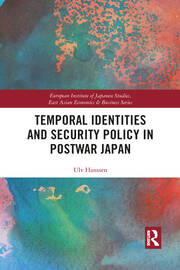
Through a discourse analysis of Japanese parliamentary debates, this book explores how different understandings of Japan’s history have led to sharply divergent security policies in the postwar period, whilst providing an explanation for the much-debated security policy changes under Abe Shinzō. Analyzing the ways identities can be constructed through ‘temporal othering,’ as well as... Read more
1. Introduction and theory
2. Two competing security discourses, 1945–1960
3. Hypothetical enemies, 1960–1970
4. The historic experiment: Refusing to become a great military power, 1970–1980
5. The emergence of the normal nation discourse, 1980–1990
6. Discursive rise and fall, 1990–2000
7. Japan as a responsible member of the international community, 2000–2010
8. Breaking out of the postwar regime, 2010–2019
9. Conclusion
Biography
Ulv Hanssen is a lecturer at Soka University, Japan, and an associate research fellow at the Swedish Institute of International Affairs. His research interests include identity in postwar Japan and Japan’s international relations.
