




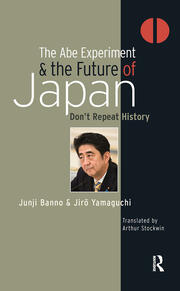
1st Edition
The Abe Experiment and the Future of Japan Don’t Repeat History
Biography
Professor Junji Banno was born in Yokohama in 1937. As a student at Tokyo University in 1960, he was a leader of student protest against revision of the Japan-US Security Treaty. In 1963, he graduated from the Department of Japanese history within the Faculty of Humanities. After graduate studies, he was appointed Professor at the Institute of Social Science of Tokyo University, where he remained until his retirement, serving as Director of the Institute for a period in the late 1990s. He also taught at Chiba University, Ochanomizu Women’s University and elsewhere in Japan, and has held various visiting fellowships including at the Australian National University and Oxford University. Between 1971 and 2012 he published more than a dozen books (and many articles) on modern Japanese history, three of which have been translated into English: The Establishment of the Japanese Constitutional System, Routledge, 1992, 1995, Democracy in Pre-War Japan: Concepts of Government, 1871-1937: Collected Essays, Routledge, 2001, Japan’s Modern History, 1857- 1937: A New Political Narrative, Routledge, 2014. Professor Jir? Yamaguchi was born in 1958 in Okayama. After graduating from the Law Faculty of Tokyo University, and teaching there as a tutor (joshu), he was for many years Professor in the Faculty of Law at Hokkaid? University, specialising in the contemporary politics of Japan. In 2014, he moved from Hokkaid? to Tokyo, where he joined the Faculty of H?sei University. Among his many publications on contemporary Japanese politics in Japanese, the following titles should be noted (translated titles): The End of Domination by the Finance Bureaucracy (1987), Collapse of the System of Single-Party Dominance (1989), Political Reform (1993), Issues in Japanese Politics (1997), British Politics; Japanese Politics (1998), Japanese Politics in Crisis (1999), Yamaguchi Jiro¯ and Ishikawa Masumi, Nihon Shakaito: Sengo kakushin no shiso to kodo (The Japan Socialist Party: Thought and Action in the Post-war Reforms), Nihon Keizai Hyoronsha, 2003. Professor Junji Banno was born in Yokohama in 1937. In 1963, he graduated from the Department of Japanese history within the Faculty of Humanities. He was appointed Professor at the Institute of Social Science of Tokyo University. Professor Jir. Yamaguchi was born in 1958 in Okayama. After graduating from the Law Faculty of Tokyo University, he was for many years Professor in the Faculty of Law at Hokkaid. University. In 2014, he moved to Tokyo, to join the Faculty of Hosei University.
