





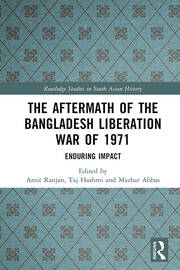
1st Edition
The Aftermath of the Bangladesh Liberation War of 1971 Enduring Impact
List of tables vii
List of contributors viii
Acknowledgements ix
Introduction x
PART I
The Liberation War, Refugees and Citizenship in India 1
1 ‘Illegal’ Migrants in Assam and West Bengal: The Socio-Politics of NRC and CAA 3
DHIMOYEE BANERJEE AND AMIT RANJAN
2 Immigrants, Evacuees or Citizens—1971 Migrants in Search of Identity 24
SUBHASRI GHOSH
PART II
The Significance of 1971 in Bangladesh: Historical and Contemporary Perspectives 49
3 Biharis in Bangladesh: Organized Elimination and Marginalization of a Community 51
TAJ HASHMI
4 Women in War Zones: Rape at the time of Bangladesh Liberation War 73
AMIT RANJAN
5 Nation-Building Policies and Ethnic Conflict in Bangladesh 95
ANURUG CHAKMA AND KISHA CHAKMA
6 Neoliberal or Quasi-Colonial: A Critique on Higher Education in Contemporary Bangladesh 114
M. MUSTAHID HUSAIN
PART III
Nationality and Identity of the Stranded Communities (Bengalis and Bihari) in Pakistan 129
7 What Does It Mean to Be a Bengali in Pakistan? 131
MAZHAR ABBAS, BILAL HASSAN AND SAMEE LASHARI
8 The Opposing Narratives on Repatriation, Resettlement, and Citizenship of Bihari Muslims in Pakistan after the 1971 War 145
SAEED AHMED RID AND MUHAMMAD QASIM SODHAR
9 The Liberation War of Bangladesh (1971) and Pakistani Media Narratives 160
FIRASAT JABEEN AND SALEEM ABBAS
Index
Biography
Amit Ranjan is a Research Fellow at the Institute of South Asian Studies, National University of Singapore. His edited book Migration, Memories and the “Unfinished” Partition (2024) is published by Routledge.
Taj Hashmi is a retired Professor of History and Security Studies. He is the author of a number of books, including Pakistan as a Peasant Utopia (Routledge, 2019).
Mazhar Abbas is a Lecturer in History at Government College University Faisalabad, Pakistan.
