





1st Edition
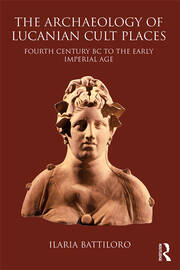
The Archaeology of Lucanian Cult Places Fourth Century BC to the Early Imperial Age
List of Figures
Acknowledgements
Foreword (Helena Fracchia)
Note on Abbreviations and Translations
Introduction
1 Lucania and Lucanians
- Lucanian Borders and Geographical Setting
- The Emergence of the Lucanian Ethnos
1.3 Social Structure: Oligarchies and "Intermediate Groups"
1.4 Political Organization: Touta and Basileis
1.5 Settlement System: a Landscape of Fortified Centres, Farms, and Extramural Sanctuaries
1.6 The Lucanian Settlement Model: an "Urban" Phenomenon?
2 Lucanian Cult Places: Topographic and Architectural Aspects
2.1 The Sanctuary: a Distinctive Sign of the Lucanian Ethnos
2.2 The Sanctuaries within the Settlement Organization of Ancient Lucania
2.3 Architecture and Space Organization
2.4 Architectural Models and Cultural Influences
3. Lucanian Cult Places: Cultic Manifestations
3.1 Votive Offerings and Ritual Practices: Archaeological Phenomenology and Historical Interpretation
3.1.1 Votive offerings: "gifts" to the gods
3.1.2 Ritual tools: communal meals, sacrifice, and fumigations
3.2 The System of Votive Offerings: Reiterated Dedications and una tantum Rituals
3.3 Lucanian Cult Places and the Emergence of the "Intermediate Groups"
4 Lucanian Cults and Pantheon Between Epigraphy and Archaeology
4.1 Water and Fertility Cults
4.2 Male Cults
4.3 Mefitis in the Sanctuary of Rossano di Vaglio: the Epigraphic Evidence
4.3.1 The etymology of Mefitis
4.3.2 Mefitis’s epithets
4.3.3 Mefitis and other deities
4.4 The Cult of Mefitis at Rossano di Vaglio: a Cross Reading of Written and Archaeological Sources
5 Lucania and the Rise of Roman Power
5.1 From Leukania to Regio III
5.2 Territorial and Administrative Change
5.2.1 The new political and institutional organization
5.2.2 Ruralization and the disappearance of hilltop centres
5.3 Social Transformations and the Vanishing of the "Intermediate Groups"
5.4 Contraction and Continuity in Lucania during the Late Republican Age
6. Lucanian Cult Places during the Late Republican Age
6.1 The Late Republican Age: Change and Continuity in Lucanian Cult Places
6.2 The Political and Social Context
6.3 The Late Republican Phases of the Sanctuary of Rossano di Vaglio
6.3.1 Restoration phases: a reconstruction
6.3.2 Votive material
6.3.4 Rossano di Vaglio in the wider context of "Italic Hellenism"
6.3.5 The management of the sanctuary during the last two centuries BC
6.4 The Role of Lucanian Sanctuaries in the Post-Hannibalic Age
7. Conclusions
Catalogue of Lucanian Cult Places
Bibliography
Index
Biography
Ilaria Battiloro is Associate Professor of Classics at Mount Allison University, New Brunswick, Canada. She is a Classical archaeologist whose research mostly focuses on the sacred architecture and ritual practices of pre-Roman Italy.
