




1st Edition
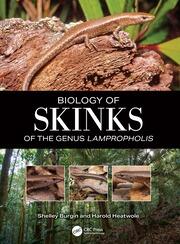
The Biology of Skinks of the Genus Lampropholis
Chapter 1 – Introduction
Chapter 2 – Distribution
Chapter 3 – Lampropholis delicata: An Invasive Stowaway
Chapter 4 – Behaviour
Chapter 5 – Natural History and Life Cycles
Chapter 6 – Thermal Biology
Chapter 7 – Physiology
Chapter 8 – What’s on the Menu? The Diet of Lampropholis
Chapter 9 – Predation on Lampropholis
Chapter 10 – Parasites and Pathogens
Chapter 11- Population Biology and the Ecological Niche
Chapter 12- Threats and Conservation
Chapter 13 – Genetics
Chapter 14 – Taxonomic and Evolutionary History
Chapter 15 – Lampropholis: An Emerging Model Taxon
Chapter 16 – Where are we now and where do we go from here?
Biography
Shelley Burgin has a PhD from Macquarie University focused on the taxonomy and phylogenic relationships of Lampropholis skinks. In 2001 was appointed ‘Fellow of the Royal Zoological Society of New South Wales; Emeritus Professor, University of Western Sydney in 2011; and Member (General Division), Order of Australia in 2018 ‘for significant service to environmental science education as an academic, author, and mentor, and to zoology and conservation’. Her research is mainly in environmental ecology/biology with approximately 200 publications, the majority on reptiles. Contribution to recent books have included co-editor with Tor Hundloe of ‘Environmental Offsets’ in 2021, and in 2015 the contribution of four chapters to ‘The Gold Coast Transformed: From Wilderness to Urban Ecosystem’ edited by Hundloe T, McDougall B, Page C. Both these books were published by CSIRO Publishing.
Harold Heatwole has four doctorates and holds Professorships at North Carolina State University and University of New England. He researches herpetology, biogeography, polar ecosystems, vegetation dynamics, as well as the ecology of ants, tardigrades, and seabirds. He was a co-editor of Volume 11, Part 6 of the Amphibian Biology series, Status of Conservation and Decline of Amphibians: Australia, New Zealand, and Pacific Islands and a co-editor of Volume 12 Reproductive Technologies and Biobanking for the Conservation of Amphibian, both published by CSIRO.
