




1st Edition
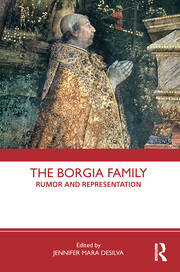
The Borgia Family Rumor and Representation
Chapter 1: What would Rome be without a good plot? Telling tales about the Borgias
Jennifer Mara DeSilva
Chapter 2: Sexuality, agency, and honor in the connections between the Borgia and Farnese families in Renaissance Rome
Loek Luiten
Chapter 3: Lucrezia Borgia’s honor
Diane Y.F. Ghirardo
Chapter 4: Lucrezia Borgia’s performances at the Este Court
Sergio Costola
Chapter 5: Electing Alexander… or not? The development and reception of a Reacting to the Past role-immersion game based on the papal conclave of 1492
William Keene Thompson
Chapter 6: Picture the Borgias: what Pope Alexander VI’s Appartamento Borgia can tell us
Roger Gill
Chapter 7: Depictions of Pope Alexander VI as the Devil
Katharine Fellows
Chapter 8: Caught between fact and fantasy: the Borgia in English literature
Stella Fletcher
Chapter 9: The Hispanic Ballad of the Death of the Duke of Gandía: propaganda against or sympathy for the Borgias?
Clara Marías
Chapter 10: Prince, villain, Fortune’s fool: is Cesare Borgia’s reputation beyond repair?
Lucinda Byatt
Chapter 11: From church to street: making meaning out of Cesare Borgia’s death and burials in Viana, Navarre
Alexander Mizumoto-Gitter
Chapter 12: The secularization of Cesare Borgia and the American Motion Picture Production Code
Jennifer Mara DeSilva
Chapter 13: Requiescat in pace: the afterlife of the Borgia in Assassin’s Creed II and Assassin’s Creed: Brotherhood
Amanda Madden
Biography
Jennifer Mara DeSilva is an associate professor of History at Ball State University. Her published research explores the mechanics of family strategy and group identity, as well as the practical realities of ecclesiastical reform in early modern Europe. Her previous publications include, as editor, The Sacralization of Space and Behaviour in the Early Modern World (2015) and Episcopal Reform and Politics in Early Modern Europe (2012).
