





1st Edition
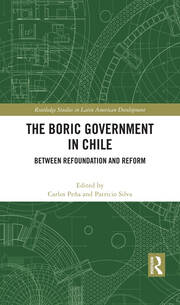
The Boric Government in Chile Between Refoundation and Reform
Boric’s Government and Its Transformative Hallmark
Carlos Peña and Patricio Silva
Part I
Boric the Politician
1 Boric and the Generational Left
Carlos Peña
2 Boric and the Legal-Constitutional Path
Javier Couso
3 Boric and the Populist Temptation
Patricio Navia
Part II
Boric and Politics
4 Boric and the Centre-Left: From Vilification to a Tactical Alliance
Patricio Silva
5 Boric’s Triumph and Disputes within the Chilean Right
Cristóbal Rovira Kaltwasser
6 Boric and the Dispute for Governability in Chile
José Joaquín Brunner
7 Social (De)Mobilisation in Boric’s Government
Camila Jara Ibarra
Part III
Boric and Public Policies
8 Boric and the Challenges for the Chilean Economy
Mauricio G. Villena
9 Social Policies in Gabriel Boric’s Government
Rossana Castiglioni
10 Public Security Challenges in Boric’s Government
Claudio Fuentes
The Challenges of the Boric Government
Carlos Peña and Patricio Silva
Biography
Carlos Peña is Rector of the Universidad Diego Portales and Professor of Civil Law at the Universidad de Chile. He is the author of several books, among others, El desafío constitucional (The Constitutional Challenge); Pensar el malestar (Modernization and Its Discontent); and Lo que el dinero sí puede comprar (What Money Can Buy). He is co- editor with Patricio Silva of Social Revolt in Chile: Triggering Factors and Possible Outcomes (Routledge, 2022).
Patricio Silva is Full Professor of Modern Latin American History at Leiden University, The Netherlands. He has authored several books and numerous articles on democratization issues in Latin America in general and in Chile in particular. He is the author of In the Name of Reason: Technocrats and Politics in Chile and Public Probity and Corruption in Chile (Routledge, 2019).
‘Since the October 2019 protests, books about Chilean politics have tended to generate more heat than light. This timely volume edited by Carlos Peña and Patricio Silva sets out to change that. Instead of tired clichés about neo-liberalism, the book provides insightful analyses of the generational nature of the movement that ushered Gabriel Boric to the presidency, the scrupulously legalistic nature of his administration, the economic and security challenges it faces, and the frightening prospect that Chile´s first government of the far left could be followed by one of the far right. A first rate volume — highly recommendable’.
Prof. Andrés Velasco, Dean of the School of Public Policy at the London School of Economics and Political Science.
