





1st Edition
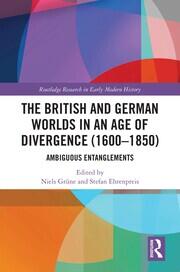
The British and German Worlds in an Age of Divergence (1600–1850) Ambiguous Entanglements
1. Agreements to Differ? Reconsidering Anglo-German Entanglements in an Age of Divergence
Niels Grüne and Stefan Ehrenpreis
Part 1: Cross-Border Transfers and Appropriations of Knowledge
2. Personal Ties and the Logistics of Information Between Early Modern Britain and the Holy Roman Empire
Tom Tölle
3. The Best of the West: German Protestants and the Church of England in the Early Eighteenth Century
Alexander Schunka
4. Reading Revolutions Across Boundaries: Entangled Political Discourses on Britain in German-Speaking Broadsheets (1642–98)
Nina Schweisthal
5. "Whigs" and "Tories" Adopted?: Resonances of British Constitutional Practice in German Political Debates (1650–1800)
Niels Grüne
Part 2: Coping with Alterity in Intergovernmental Contacts
6. Frail Heirs, Fleeting Information: Stepney, Leibniz, and the Transfer of Dynastic Knowledge Around 1700
Tom Tölle
7. An Intercultural Royal Marriage and Experiences of Difference at the English Court: Mary of Modena (1658–1718) as a Carrier of Culture and Political Influencer
Elena Taddei
8. Perception and Entanglement in Diplomacy: Count Johann Wenzel Gallas Witnessing London During the War of the Spanish Succession
Robert Rebitsch
9. A British Agent in and from Germany: The Multiple Roles of Alexander (Maurus) Horn (1762–1820)
Claus Oberhauser
Part 3: Ideologising the Cultural Nation
10. The View from Outside: British Travellers' Encounters with the German World in the First Half of the Nineteenth Century
Martin Schaller
11. Public Spirit and Public Opinion in Britain and Germany, 1789–1825
Maike Oergel
Biography
Niels Grüne is Associate Professor of Modern History at Innsbruck University. He received his Ph.D. from Bielefeld University and was previously a fellow of the Freiburg Institute for Advanced Studies. His research explores the social, cultural, and political history of sixteenth- to nineteenth-century Europe.
Stefan Ehrenpreis is Professor of Modern History at Innsbruck University. He received his Ph.D. from Bochum University and gained his habilitation at the Humboldt University Berlin. His main research areas are the Holy Roman Empire, the history of religion, and educational history in the early modern period.
