





1st Edition
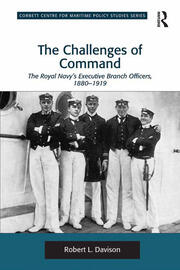
The Challenges of Command The Royal Navy's Executive Branch Officers, 1880-1919
By Robert L. Davison
Copyright 2011
304 Pages
by
Routledge
304 Pages
by
Routledge
304 Pages
by
Routledge
Also available as eBook on:
In the period leading up to the First World War Britain's naval supremacy was challenged by an arms race with Germany, fuelled not only by military and geo-strategic rivalries, but an onrush of technological developments. As this book demonstrates, steam turbines, bigger guns, mechanical computing devices and ever increasing tonnage meant that the Royal Navy was forced to confront many... Read more
Contents: Introduction; Social change and the officer corps; The 19th-century officer corps; Threats to professional status; 'Oh, theses magicians and necromancers, they are ruining us' - the clash of sailors and engineers; The reinvention of the officer corps; History as a professional tool; Journals and staffs: organizational change; Auxilium ab alto - the experience of war; Conclusion; Appendices; Bibliography; Index.
Biography
Robert L. Davison, Wilfrid Laurier University, Canada.
'Davison’s account is always intriguing and throws a different light on some of the internal battles fought within the pre-1914 Royal Navy. It is a refreshing look at an old problem and highly recommended to anyone with an interest in the organizational development of the Royal Navy.' Mariner’s Mirror 'Davison’s analysis is original in conception, significant in substance, and made readily accessible through clear writing and well-structures exposition of argument... The Challenges of Command is a fine achievement that sets a high standard for future work in this area.' Canadian Journal of History 'We have been told often enough about the varied difficulties facing British society during the forty years or so before the outbreak of the First World war... What we have not had before is a study of how British naval executive officers reacted to the challenges; here Robert Davison enters a new and fertile area.' International Journal of Maritime History
