




1st Edition
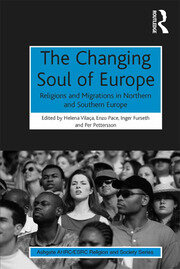
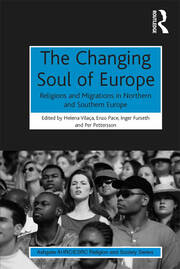
The Changing Soul of Europe Religions and Migrations in Northern and Southern Europe
Introduction
PART I: Theoretical Remarks
1 Religion in Motion: Migration, Religion and Social Theory
Enzo Pace
2 New Economy, Migration and Social Change: The Impact on Religion
José Madureira Pinto
3 Immigrant Religions and the Context of Reception in Advanced Industrial Societies
Tuomas Martikainen
PART II: Religion And Migration In Europe: Case Studies
4 Migration and Ethno-Religious Identity in Contemporary Greece: The Role of the Orthodox Church
Elisabeth A. Diamantopoulou
5 How the Portuguese Catholic Church is dealing with Newcomers: The Particular Case of Eastern European Immigrants
Helena Vilaça
6 Beyond Parishes: Challenges of Catholic-Christian Second Generations
Roberta Ricucci
7 Ethnic and Religious Diversities in Portugal: The Case of Brazilian Evangelical Immigrants
Donizete Rodrigues
8 Accommodation and Tension: African Christian Communities and their Swedish Hosts
Anne Kubai
9 Young Muslim Women’s Public Self-Representations: A New Generation of Italians Seeking Legitimacy
Annalisa Frisina
10 Values and Religion in Transition: A Case Study of a Swedish Multicultural Public School
Per Pettersson
11 Hijab Street Fashion and Style in Oslo
Inger Furseth
12 Religiousity and Ethnicity: Vietnamese Immigrant Religion in Denmark
Jørn Borup
Biography
Helena Vilaça is member of the council of the International Society for the Sociology of Religion, representing Iberia, and her scientific work has been significantly dominated by religion.She is the author of From the Babel Tower to the Promised Lands: Religious Pluralism in Portugal (2006), and Religion in Motion: Migrants and Religious Diversity in Portugal and Italy (2012), edited with Enzo Pace. Enzo Pace is Visiting Professor at the Ecole des Hautes Etudes en Sciences Sociales and Past-President of the International Society for the Sociology of Religion. Recent publications include Islam in Europe (2010); (eds. with H. VILAÇA), Religion as Communication (2011); Il carisma, la fede, la chiesa. Introduzione alla sociologia del cristianesimo, (2012); (ed.) Le religioni nell’Italia che cambia, (2013). Inger Furseth is professor of sociology at University of Oslo and the director of the research program NOREL (The role of religion in the public sphere: A comparative study of the five Nordic countries). Her publications include A Comparative Study of Social and Religious Movements in Norway, 1780s-1905 (2001), From Quest for Truth to Being Oneself (2006), and An Introduction to the Sociology of Religion (2006, with PÃ¥l Repstad). Her research centers on public religion, religious diversity, gender issues, social and religious movements, and social theory. Per Pettersson is guest professor at Uppsala Religion and Society Research Centre - CRS, at Uppsala University (Sweden) and director of CRS ten year long research programme; The Impact of Religion Challenges for Society, Law and Democracy, 2008-2018. He is mainly involved in international comparative research. Recent publications include; State and Religion in Sweden: Ambiguity between Disestablishment and Religious Control (2011); Majority Churches as Agents of European Welfare: A Sociological Approach (in A. Bäckström, G. Davie, and N. Edgardh, eds., Welfare and Religion in 21st Century Europe. 2011)
’The relevance of The Changing Soul of Europe extends far beyond its stated geographic limits. Vilaça et al. have drawn together a superb collection of essays that together map and explain shifts in the soul of Europe and which is sure to illuminate similar shifts in other religious landscapes, including Canada, the United States and Australia. Rich in theoretical and empirical insights, this volume is an essential contribution to scholarship on migration, religion and diversity and religion in motion. The radically new terrain on which we find ourselves in relation to religion requires the creative thinking and genuinely innovative approaches offered in this volume.’ Lori G. Beaman, University of Ottawa, Canada
