




1st Edition
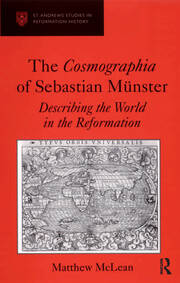
The Cosmographia of Sebastian Münster Describing the World in the Reformation
By Matthew McLean
Copyright 2007
392 Pages
by
Routledge
392 Pages
by
Routledge
Also available as eBook on:
Sebastian Münster's Cosmographia was an immensely influential book that attempted to describe the entire world across all of human history and analyse its constituent elements of geography, history, ethnography, zoology and botany. First published in 1544 it went through thirty-five editions and was published in five languages, making it one of the most important books of the Reformation period.... Read more
Contents: Introduction; Sebastian Münster: a brief biography; 16th-century cosmography: its sources, development and ambitions; The Cosmographia: genesis of an idea, methods of realisation, versions of the text; From centre to periphery: the organisation, topics and content of the Cosmographiae Universalis; Understanding the world of Münster's Cosmographia: evaluating man, celebrating his works and interpreting the book of the world; Conclusion; Bibliography; Index.
Biography
Matthew McLean is a research fellow at the University of St Andrews, UK.
’In this book, his first, Matthew McLean demonstrates great depth of research, a mind capable of lateral thinking and the ability to capture the interest of his reader... this book delivers a well researched examination of the context and creation of Sebastian Münster's Cosmographia.’ Rare Books Newsletter ’...McLean has achieve a Herculean task in analysing one of the greatest publishing enterprises of the sixteenth century.’ The Library ’... a thoughtful and probing work, full of interesting asides and arresting turns of phrase...’ Bulletin of the German Historical Institute ’To sum up, this is a major study of one of the most outstanding works of Renaissance Europe that should be read by historians of science and technology, and by all those interested in the culture of this exciting time.’ Metascience ’The reader of McLean’s work will certainly feel his knowledge and understanding of early modern humanist scholarship enhanced; it is a worthy contribution to what is surely one of the most intellectually stimulating and attractively produced series on the market.’ Sixteenth Century Journal
