




1st Edition
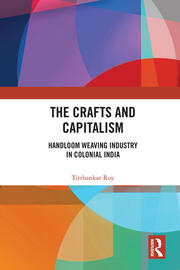
The Crafts and Capitalism Handloom Weaving Industry in Colonial India
List of Figures, Maps, Tables
Preface
1. Introduction
2. Scale and Composition, 1795-1940
3. Consumption and Market
4. Capital and Labour
5. Tools and Techniques
6. Towns and Regions
7. Handlooms and Powerlooms, 1920-1990
8. Handloom after Independence
Glossary
Selected Biographies
References
Index
Biography
Tirthankar Roy is Professor of Economic History, London School of Economics and Political Science, UK where he teaches South Asia and Global History. He is the author of India in the World Economy: From Antiquity to the Present (2012); Law and the Economy in Colonial India (with Anand V. Swamy, 2016); and The Economy of South Asia from 1950 to the Present (2017). His research interests are history and development of South Asia, global history, empires, and environmental history.
‘The literature on decline and survival of the handloom sector in India in the nineteenth century had been ideological, focusing on the British policies of deliberate destruction of the industry. This book, based on data and quantitative estimation rather than preconceived assertions, is a much-needed contribution to the literature. A leading contributor to Indian economic history, Roy more than anybody else is well positioned to write this narrative.’
Bishnupriya Gupta, Professor of Economics, University of Warwick, UK
‘Given the continued importance of artisanship generally and handloom weaving particularly, both in cultural and economic terms, the book would be likely to find a wide audience among development workers, those interested in cultural heritage, as well as anyone interested in economic history more broadly.’
Abigail McGowan, Associate Professor of History & Associate Dean of the College of Arts and Sciences, University of Vermont, USA
