




1st Edition
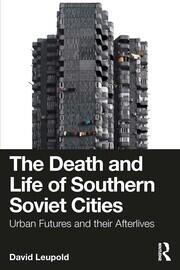
The Death and Life of Southern Soviet Cities Urban Futures and their Afterlives
Introduction
I: What is Left of the Future City? Southern Soviet Cities as Legacy and Horizon
II: The Esperanto-Speaking City-Builders: The Industrial Commune "Interhelpo" and Bottom-Up Urbanity in early-Soviet Bishkek
III: “For us the Desert is Buzzing Cities”: Rooted Urbanity in early Soviet Yerevan between Constructivism and Armenian Futurism
IV: Building the 15-Minute City in the Steppe: The Kichi-Raion and Polycentric Urbanity in post-Stalinist Bishkek
V: From Science Town to Ecopolis: A Kyrgyz-Jewish Philosopher and Ecocentric Urbanity in late-Soviet Pushchino
VI: The Right to the Cosmos: Reclaiming Public Urbanity at the Soviet Planetarium
VII: The Past is a Foreign City: The Resuscitation of the Soviet-Armenian novel “Yerevan” (1931) and the Haunting of Eastern Urbanity
Conclusion
Biography
David Leupold is an interdisciplinary social scientist, scholar of memory studies, and winner of the book award of the Central Eurasian Studies Society. Following his fellowship at the University of Michigan, he is currently pursuing his qualification for full professorship at the Humboldt-Universität zu Berlin.
"Exploring the material and mnemonic legacies of socialist-era urbanisation, the book focuses on the peripheries of the former USSR – often overlooked geographies of the “Soviet South”, primarily Bishkek, the capital of Kyrgyzstan in Central Asia, and Yerevan, the capital of Armenia in the South Caucasus. Leupold combines historical analysis with insights from architecture, urban sociology, and long-term ethnographic research, complemented by numerous historical and contemporary illustrations. Leupold draws on a rich array of archival sources in Armenian, Czech, Kyrgyz, Russian, and Slovak, alongside extensive interviews and visual documentation. This interdisciplinary approach makes the work a significant contribution to scholarship in urban studies, Soviet and postSoviet history, anthropology, and postcolonial studies. Its central academic contribution lies in applying theories of uneven geographical development to the specific contexts of the Global South. Rather than offering a nostalgic reflection, Leupold seeks to rehabilitate the possibility of utopian thinking by tracing how these cities have transitioned from envisioned “cities of the future” to embattled urban spaces increasingly shaped by processes of spatial commodification in the post-Soviet era. Ultimately, Leupold’s book reads as an obituary for an “assassinated future”, one whose ghost continues to haunt the present urban landscape. By recovering this “unpassed experience” of solidarity and planning from beneath layers of ethno-nationalist mythology and neoliberal development, Leupold reminds readers of the possibility of an alternative urban trajectory. For those seeking to reclaim the “right to the city”, the book offers a compelling argument for reading the urban landscape not merely as a collection of property assets, but as a terrain of historical struggle and potential democratic transformation. It is a masterful, provocative, and timely intervention in how we understand the past, present, and possible futures of cities in the Global South."
Eldiyar Sultanaliev, in Central Asia Analytical Digest (April 2006): 20.
“We are now far enough away from the end of the Soviet Union and its attendant internationalism that more nuanced and objective, less partisan and accusatory, accounts of Soviet history can be written. Leupold’s work presents to both a scholarly audience of historians, sociologists, political scientists, and urban researchers, as well as graduate students and a broader readership interested in the USSR and urban studies a unique way of rethinking Soviet history. This will be an extraordinarily important book.”
Ronald G. Suny, William H. Sewell Jr Distinguished University Professor of History, University of Michigan
“David Leupold delivers an original-because-richly comparative take on socialist experiment on the USSR’s peripheries. Offering a granular historical perspective that is complemented by extensive travel, he creatively leans on urban landscapes to show how contemporary citizens of Armenia, Kyrgyzstan, and beyond reflect on the entire socialist period. As Slovenian philosopher Slavoj Zizek has asked: now that socialism is over, does it all get jettisoned? David Leupold convinces us that in the world of urban planning, socialist legacies have something important to tell us.”
Bruce Grant, Professor of Anthropology, New York University
“The Death and Life of Southern Soviet Cities offers a compelling and valuable contribution to the study of urbanism, socialism, and post-socialist transformations, particularly in the context of Central Asia and the Southern Caucasus. By combining historical analysis with ethnographic research, the book provides a nuanced understanding of how socialist urban ideologies continue to impact these regions. This dual approach helps bridge gaps between theoretical frameworks and lived experiences, offering a more holistic view of urban transformation. The book's focus on four competing urban visions (bottom-up, rooted, polycentric, and ecocentric urbanity) promises to illuminate diverse conceptualizations of urbanism that emerged within the Soviet South. This approach highlights how different ideas about urban space and planning were envisioned and how they continue to influence contemporary urban landscapes.”
Tamta Khalvashi, Professor of Anthropology and head of the PhD Program of Social and Cultural Anthropology, Ilia State University in Georgia
