




1st Edition
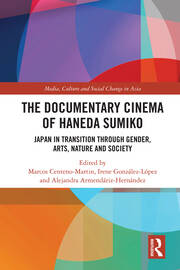
The Documentary Cinema of Haneda Sumiko Japan in Transition through Gender, Arts, Nature and Society
Haneda Sumiko’s Oeuvre. An Introduction.
Marcos Centeno-Martin, Irene González-López and Alejandra Armendáriz-Hernández
GENDER DYNAMICS AND THE REPRESENTATION OF WOMEN
1. Adding a Gender Perspective to Iwanami Documentaries: Women’s College in the Village (1957).
Marcos Centeno-Martin and Ayako Saito
2. Akiko (1985): Portrait of an Indomitable Force.
Irene González-López
CULTURAL HERITAGE
3. Resurrecting Dedicated Treasures of Horyuji-Temple (1971): a Cinematic Poem on Absence, Melancholy, and the Passage of Time.
Marcos Centeno-Martin and Raúl Fortes-Guerrero
4. A Gaze at the Ordinary People in Genre Paintings in the Late 16th Century (1967).
Makiko Kamiya
5. The Art/s and The Artist/s: Japanese Scroll Painting, Art Documentaries and Haneda Sumiko’s Journey into a Picture Scroll.
Adam Bingham
TRADITIONAL THEATRE ARTS
6. Kyōgen (1969), the Mirror of Tradition. In Search of Identity through Performing Arts. Raúl Fortes-Guerrero
7. The Ontology of an Actor’s Body: Documenting the Last Years of Kataoka Nizaemon’s Life.
Ayumi Fujioka
NATURAL SCIENCES AND ECO-CINEMA
8. Haneda Sumiko Runs through a Cabbage Field: The Challenge of The Cabbage Butterfly (1968).
Hidenori Okada
9. Visualizing Invisible Contamination: Haneda Sumiko’s TV Programs on Environmental Pollution.
Koji Toba
10. The Cherry Tree with Grey Blossoms (1977): An Ecology of the Everyday.
Anne McKnight
HISTORY AND MEMORY OF ‘VANISHING’ JAPAN
11. Haneda’s Beauty of the Ancients (1958) and Traumascapes: Re-membering Japanese Culture through Documentary Film.
Dolores P. Martinez
12. Ode to Mt. Hayachine (1982). Between an End of an Era, and the Dawn of a New One: Capturing the Flow of History.
Matteo Boscarol
13. Haneda’s Transnational Cinema: From Diasporic Cinema to Mnemonic Journey Films. The case of The Japanese Settlers… (2008).
Marcos Centeno-Martin
AGING
14. Confronting the Forgotten: Unveiling the World of the Elderly with Dementia through The World of Dementia (1986).
Lu Siyu
15. Gendered Citizenship, Democracy, and Welfare Reform in Getting Old without Anxiety (1990) and the Takanosu trilogy (1997-2006).
Diane Wei Lewis
16. Critiquing Ideal Aging: Food, Care, and Detachment in Haneda Sumiko’s All’s Well that Ends Well (2006) and Other Documentaries.
Yutaka Kubo
ANNEXES
17. Interview with Satō Tokue, Filmmaker, Haneda Sumiko’s Personal Assistant and Manager of Kanatasha, Inc.
Irene González-López
18. The Eye of the Documentarist. Interview with Director Haneda Sumiko.
Kaneko Yū (Translated by Maria Roemer)
19. Haneda Sumiko’s Filmography.
Biography
Marcos Centeno-Martin is Associate Professor in Film and Media and Japanese Studies at the University of Valencia, Spain, and Research Associate for the Japan Research Centre at SOAS, UK.
Irene González-López is Lecturer in Japanese Studies at Birkbeck, University of London, UK.
Alejandra Armendáriz-Hernández currently works at The Japan Society in London and holds a PhD from University Rey Juan Carlos in Madrid, Spain.
