



1st Edition
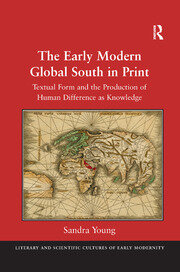
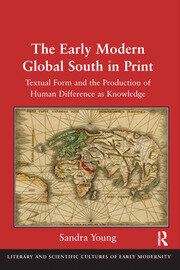
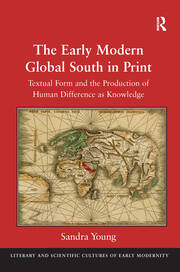
The Early Modern Global South in Print Textual Form and the Production of Human Difference as Knowledge
By Sandra Young
Copyright 2015
228 Pages
by
Routledge
228 Pages
by
Routledge
228 Pages
by
Routledge
Also available as eBook on:
Early modern geographers and compilers of travel narratives drew on a lexicon derived from cartography’s seemingly unchanging coordinates to explain human diversity. Sandra Young’s inquiry into the partisan knowledge practices of early modernity brings to light the emergence of the early modern global south. Young proposes a new set of terms with which to understand the racialized imaginary... Read more
List of Figures and Plates
Acknowledgements
- Introduction: Searching the Secrets of Nature in the "South"
- Constructing a Global South in Print
- Picturing New Worlds
- Mapping the Whole World
- Navigating across Oceans
- Making Daily Notes
- Collecting Curiosities
- Reporting on Colonial Violence
- Editing Africa in the New Geographies
Afterword: Race and Racism in Early Modernity
Bibliography
Index
Biography
Sandra Young is a Professor, and Convenor of the Masters Program, in the Department of English at the University of Cape Town, South Africa.
'This exquisitely-crafted study demonstrates how the visual language of early modern book-making rendered new worlds and peoples legible. Paying attention to the inside and outside of books, to their sentences as well as their material form, this meticulous volume shows how the conceptual grid of cardinal points came to construct ideas of "southern climes" and "the south". The study moves beyond postcolonial theories of self and other, offering wisdom for early modernists, postcolonial theorists, book historians, and literary and historical scholars. A cardinal study, in every sense of the word.' Isabel Hofmeyr, University of the Witwatersrand, Johannesburg, South Africa and New York University, USA
