




1st Edition
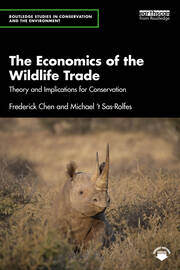
The Economics of the Wildlife Trade Theory and Implications for Conservation
1. Introduction 2. Wildlife Conservation and Trade: Theory and Practice 3. Markets for Wildlife Goods 4. An Economic Model of the Market for Wildlife Goods 5. The Economic Model with Substitute Goods and Complete Information 6. The Economic Model with Substitute Goods and Asymmetric Information 7. The Economic Model with Speculators and Stockpiling 8. Influencing Actor Incentives in Wildlife Trade 9. Toward More Effective Wildlife Trade Regulation 10. Conclusions
Biography
Frederick Chen is a Professor in the Department of Economics at Wake Forest University, USA. He teaches microeconomics, mathematical economics, and game theory. His current research interests lie mainly in the intersection of economics and population biology.
Michael ’t Sas- Rolfes is an interdisciplinary conservation scientist and economist with four decades of experience in the wildlife sector. He is a Research Fellow at the Interdisciplinary Centre for Conservation Science and the Oxford Martin Programme on Wildlife Trade at the University of Oxford, UK, and at the African Wildlife Economy Institute at Stellenbosch University, South Africa. He serves on the IUCN Species Survival Commission’s African Rhino Specialist Group and its Sustainable Use and Livelihoods Group.
