





1st Edition
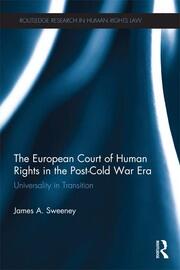
The European Court of Human Rights in the Post-Cold War Era Universality in Transition
1. The Council of Europe, Transitional Justice, and the Universality of Human Rights Part 1: The ECHR and Transitional Policies 2. Transitional Criminal Justice: Prosecution and Amnesty 3. Openness, Secrecy and Historical Justice 4. Reparatory Justice and the Restitution of Property 5. Lustration Part 2: Democratic Rights in the Transitional Context 6. Freedom of Expression 7. Freedom of Assembly and (Religious) Association 8. Free Elections 9. Universality in Transition
Biography
Dr James A. Sweeney is a Senior Lecturer in Law at Durham University, UK. He is also Deputy Director of Durham Global Security Institute. Dr Sweeney has acted as an expert advisor to the Council of Europe in relation to freedom of assembly projects in Armenia, Azerbaijan (with the Venice Commission), Georgia, and Kosovo. In March 2011 he delivered human rights legal training to judges of the Ukrainian Supreme Court as part of a UK Foreign and Commonwealth Office project. Throughout 2009 he acted as an expert advisor to the EU's Committee of the Regions as it prepared its Opinion on reforms to the Common European Asylum System. His work on the human rights of failed asylum seekers has been cited by both the UK House of Lords (in its former judicial capacity) and the Court of Appeal.
"Sweeney has made an important contribution to the literature on transitional justice and how human rights law can play a constructive role beyond simply setting goalposts for universal principles." D. A. Messenger, University of Wyoming,
