




1st Edition
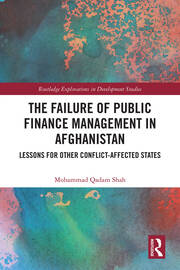
The Failure of Public Finance Management in Afghanistan Lessons for Other Conflict-Affected States
CHAPTER ONE
State Building and Public Finance Reform in Conflict-Affected States
CHAPTER TWO
The Origins of Afghanistan’s Fiscal Capacity (1747-2001)
CHAPTER THREE
Enduring Centralization: Public Finance Reforms and the Struggle for Decentralization in Afghanistan (2001–2021)
CHAPTER FOUR
Deconcentrated Planning and Budgeting in Action: Evaluating Afghanistan’s PDPG and PBP Performance (2016-2019)
CHAPTER FIVE
Unveiling Informal Dynamics: The Politics and Strategies Behind Afghanistan’s Discretionary Development Budget Allocation
CHAPTER SIX
Informal Dynamics in Action: The Tale of Four Afghan Provinces
CHAPTER SEVEN
The Taliban’s Return to Power in 2021: Governance, Humanitarian Aid, and Public Finance
CHAPTER EIGHT
Lessons for Other Conflict-Affected States
Biography
Mohammad Qadam Shah is Assistant Professor of Global Development at Seattle Pacific University, USA.
This book offers a critical examination of Afghanistan’s public finance system, illustrating how political motives, rather than technical reforms, dictated the distribution of public funds. By employing a historical institutional approach and drawing on extensive fieldwork, the author reveals how centralized planning persisted despite numerous attempts at reform, shedding light on the complex dynamics that shaped Afghanistan’s state-building process. This insightful analysis is essential for anyone studying the intersection of politics, aid, and governance in conflict-affected states.
Scott Fritzen, President, Fulbright University Vietnam
Mohammad Qadam Shah’s The Failure of Public Finance Management in Afghanistan is essential reading for anyone interested in public finance reform under challenging conditions. This book offers a meticulously researched explanation of why the reconstruction effort in Afghanistan from 2001 until 2021 ultimately failed to prevent the Taliban’s return to power. Qadam Shah’s book emphasizes that the main reasons for the failures of post-conflict reconstruction lie in timeless questions about public administration and the perils of centralized public administration. It is an impassioned and thoughtful call to devote more attention to getting public administration reform "right" to promote peace and prosperity in conflict-affected states.
Ilia Murtazashvili, Professor, Graduate School of Public and International Affairs; Associate Director, Center for Governance and Markets, Campbell Visiting Fellow at the Hoover Institution, Stanford University
