





1st Edition
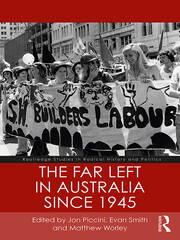
The Far Left in Australia since 1945
-
Introduction: The history of the far left in Australia since 1945 – Jon Piccini, Evan Smith and Matthew Worley Part 1: Organisational Histories. 2. Australian Communism in Crisis: 1956 – Phillip Deery. 3. The Current of Maoism in the Australian Far Left – Drew Cottle and Angela Keys. 4. Breaking with Moscow: the Communist Party of Australia's new road to socialism – David McKnight, 5. ‘The "White Australia" policy must go’: The Communist Party of Australia and immigration restriction – Jon Piccini and Evan Smith Part 2: The 1950s and 1960s – In and out of the Cold War. 6. The Far Left and the Fight For Aboriginal Rights: The Formation of the Council for Aboriginal Rights (CAR), 1951 – Jennifer Clark, 7. How far left? Negotiating radicalism in Australian anti-nuclear politics in the 1960s – Kyle Harvey, 8. "1968" in Australia: The Student Movement and the New Left – Russell Marks Part 3: The 1960s and 1970s – The valences of Liberation. 9. Changing Consciousness, Changing Lifestyles: Australia’s Women Liberation, the Left and the Politics of ‘Personal Solutions’ – Isobelle Barrett Meyering, 10. Black Power and White solidarity: The Action Conference on Racism and Education, Brisbane 1972 – Lewis d’Avigdor, 11. The Australian Left and Gay Liberation: From 1945 to 2000s – Liz Ross, 12. Beating BHP: The Wollongong Jobs for Women Campaign 1980 – 1991 – Diana Covell Part 4: Mainstreaming the far left. 13. Halcyon Days? The Amalgamated Metal Workers’ Union and the Accord – Elizabeth Humphrys, 14. Reading and Contesting Germaine Greer and Dennis Altman: the 1970s and Beyond – Jon Piccini and Ana Stevenson, 15. The Cultural Front: Left Cultural Activism in the Post-War Era – Lisa Milner
Biography
Jon Piccini, University of Queensland, Australia.
Evan Smith, Flinders University, Australia.
Matthew Worley, University of Reading, UK.
"The contributors and editors have delivered on their claims to ‘begin the process of properly piecing together the far left’s long-term impact on Australia’ in service of activist history by heeding Walter Benjamin’s bid to ‘appropriate a memory as it flashes up in a moment of danger’ (14). This is an indispensable resource that is essential reading for all students and would-be practitioners of activist history."
- Joe Collins, Australian Historical Studies
