





1st Edition
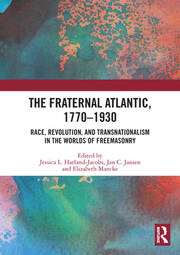
The Fraternal Atlantic, 1770–1930 Race, Revolution, and Transnationalism in the Worlds of Freemasonry
The fraternal Atlantic: An introduction
Jessica L. Harland-Jacobs, Jan C. Jansen and Elizabeth Mancke
Part I: Revolutions
1. From a cosmopolitan fraternity to an imperialist institution: Freemasonry in British North America in the 1780s–1790s
Bonnie Huskins
2. Brothers in exile: Masonic lodges and the refugees of the Haitian Revolution, 1790s–1820
Jan C. Jansen
Part II: Race
3. A secret brotherhood? The question of black Freemasonry before and after the Haitian Revolution
John D. Garrigus
4. "Perfectly proper and conciliating": Jean-Pierre Boyer, freemasonry, and the revolutionary Atlantic in eastern Connecticut, 1800–1801
Peter P. Hinks
Part III: Tensions
5. Atlantic antagonism: Revolution and race in German-American Masonic relations, 1848–1861
Andreas Önnerfors
6. The great divide: Transatlantic brothering and masonic internationalism, c. 1890–c. 1930
Joachim Berger
Biography
Jessica L. Harland-Jacobs is Associate Professor of History at the University of Florida, USA; her research focuses on the British Empire and comparative imperialism.
Jan C. Jansen is a professor of global history at the University of Duisburg-Essen, Germany. His research interests include comparative imperial history, refugee history, and the history of the Atlantic and Mediterranean worlds.
Elizabeth Mancke studies the geopolitical impact of European expansion on systems of governance. She is a Canada Research Chair in Atlantic Canada Studies at the University of New Brunswick, Canada.
