




1st Edition
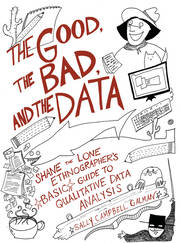
The Good, the Bad, and the Data Shane the Lone Ethnographer’s Basic Guide to Qualitative Data Analysis
By Sally Campbell Pirie
Copyright 2013
104 Pages
by
Routledge
103 Pages
by
Routledge
Also available as eBook on:
Data analysis is often the most difficult task facing students and novice qualitative researchers, including Shane the Lone Ethnographer—a grad student with fond visions of the Wild West—and her horse Transcriptor. In this comic-style textbook, we follow Shane as she attempts to corral her data and make sense of it for publication. Shane learns how to read, sort, code, write, and assess the... Read more
Preface1. Showdown at the Coffeehouse (Introduction)2. On the Trail of the Lonesome Data Analyst: An overview of qualitative analytic strategy and assumptions3. They Coded With Their Boots On: Coding 1014. Write, Vaquero! Writing about data5. The Great Train Robbery: Doing basic narrative analysis6. The Discourse Kid: Doing basic discourse analysis7. Sure is Purdy, But Can You Eat It? Understanding and analyzing unwieldy data8. Calamity Shane! What to do when you suddenly realize something ain't right.9. Time to Hit the Old, Dusty Audit Trail: Reliability and validity concerns10. Return to the Cookbook of the Sierra Madre: Putting it all togetherAppendix: Shovels, Six-Guns and Spurs: Technology from PCs to Post-itsWorks Cited and Other Important Things for Further ReadingAbout the Author
Biography
Sally Campbell Pirie
“Slices to the heart of qualitative data analysis.” —Zorro
“Transcriptor knows more about qualitative analysis than any horse alive.”—Trigger
“Will help me immensely in analyzing stagecoach patterns along the Oregon Trail.”—Black Bart
“Galman helps undermine the Western colonialist project by providing researchers with tools to give voice to marginalized populations.”—Geronimo
“Sally Galman shoots straight in advising how to best analyze a qualitative project.” —Annie Oakley
“Galman's book is inspiring and creative for students and faculty alike. Each page is packed with meaning and captures the entire qualitative research process. This is uniquely intelligent, original, and artistic in style, content, form, and presentation. In my Advanced Qualitative Methods class this semester, this book is universally loved.”—Valerie J. Janesick, University of South Florida
