





1st Edition
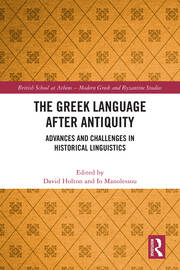
The Greek Language after Antiquity Advances and Challenges in Historical Linguistics
Introduction
David Holton and Io Manolessou
1. The regional diversification of Greek AD
Io Manolessou
2. Investigating the diachronic phonology of Medieval and Modern Greek through graphemic evidence
Nikolaos Pantelidis
3. Language contact in Late Medieval Greek: an under-estimated phenomenon?
Theodore Markopoulos
4. Philology and φιλολογία: linguistic variation in Medieval and Early Modern Greek from the viewpoint of textual scholarship
Tina Lendari
5. Many linguistic ways to tell the same story: the four versions of the Life of Maximos the Hutburner
Martin Hinterberger
6. Medieval and Early Modern Greek derivational morphology: the missing chapters
Tina Lendari and Io Manolessou
7. Compounding in Cretan across centuries
Angela Ralli and Georgios Chairetakis
8. Issues in the historical semantic analysis of Modern Greek
Christina Bassea-Bezantakou
Biography
David Holton is Emeritus Professor of Modern Greek at the University of Cambridge and an Emeritus Fellow of Selwyn College. He has published widely on Greek language and literature from Late Medieval to Modern, particularly Cretan and Cypriot poetry of the Renaissance period. He edited Literature and Society in Renaissance Crete (1991; Greek edition 1997). He is the co-author of two grammars of Modern Greek, and he directed the research project that produced The Cambridge Grammar of Medieval and Early Modern Greek (4 vols., 2019). He holds an honorary doctorate from the Aristotle University of Thessaloniki (2024).
Io Manolessou is the Acting Director of the Research Centre for Modern Greek Dialects of the Academy of Athens. She holds a PhD in historical linguistics from the University of Cambridge and has published many papers on the history of the Greek language and its dialects. Major contributions include the Cambridge Grammar of Medieval and Early Modern Greek (co- author, 2019), vol. 7 of the Historical Dictionary of Modern Greek (chief editor, 2021), and the Historical Dictionary of the Dialects of Cappadocia (chief editor, 2024).
‘… this volume delivers on its aims to fill in some gaps in our knowledge of the Greek language ‘after antiquity’. Its contributors do so by diving into understudied topics such as derivational morphology and compounding, re-evaluating crucial historical questions of dialect diversification and language contact with new frameworks, and, most of all, by capitalizing on new tools to reconstruct the development of the Greek language’ - Bryn Mawr Classical Review (2026).
