





1st Edition
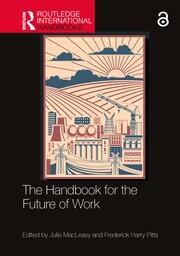
The Handbook for the Future of Work
List of tables
List of figures
List of contributors
Acknowledgements
Part I: Introduction
1. An Introduction to The Handbook for the Future of Work
Julie MacLeavy and Frederick Harry Pitts
Part 2: Futures of Work in Context
2. The future of work: A history
Tim Strangleman
3. What is the fourth industrial revolution? Towards a critical theory of the future of work
Greig Charnock
4. Financialisation of work futures
Jean Cushen and Paul Thompson
Part 3: Automation, Technology and the Future of Work
5. The political economy of labour and technological disruptions in capitalism
Elena Papagiannaki
6. Automation and the future of work
James Steinhoff
7. Resisting determinism(s): Unpacking cognitive technology and automation
Abigail Gilbert
Part 4: Platforms, Platform Labour and Gig Work
8. Platform labour and gig work futures: Uncovering women’s hidden digital labour
Al James
9. Non-labour platforms and their effects on work in specific sectors: a major gap in recent research on work and employment
David Hesmondhalgh and Charles Umney
10. Fighting the algorithm: The rise of activism in the face of platform inequality
Kalie M. Mayberry, Lindsey D. Cameron and Hatim A. Rahman
Part 5: Identity and Difference in the Future of Work
11. A future of racial capitalism: Reproducing coercion through new digital labour in South Africa
Bridget Kenny
12. Disability and the Future of Work
Melanie Jones, Kim Hoque, Victoria Wass and Nicholas Bacon
13. Work, wealth and the future: Evolving class structures and social mobility in a changing world of work
Julie MacLeavy
Part 6: Gender, Care and Social Reproduction
14. Gender and The Future of Work in the Affective and Agile Economies
M. Winter
15. Queering the Future of Work: Queer and trans temporalities for (re)thinking work and social reproduction
Lizzie Richardson and Daniel Cockayne
16. Care and the Future of Work
Karin Schwiter
Part 7: Sectoral Case Studies
17. Services are the future of work
Mattew Cole
18. Industry 5.0 and the future of work in manufacturing in Australia
Darryn Snell, Mark Dean and Al Rainnie
19. A means to an end? The role of technology in growth and post-growth futures of agrifood work in a European context
Costantine Manolchev, David Watson, Laura A. Colombo, Patrick Elf and James Scott Vandeventer
Part 8: Labour Market Transitions and Insecurity
20. Young Workers: Understanding labour market transitions and improving job quality
Edward Yates
21. Considering the futures of unpaid work
Nancy Worth
22. Navigating self-employment in the evolving landscape of work: reflecting on the past and anticipating the future
Paolo Borghi
Part 9: Mobilities and Geographies of Work Futures
23. Global production and the future of work: Past, present and futures of just-in-time
Rutvica Andrijasevic, Julie Yujie Chen and Marc Steinberg
24. Reshaping the geography of work: Remote worker migration and regional dynamics in the post-pandemic era
Julie Macleavy, Suzanne Mills, Katie Mazer and Darja Reuschke
25. Resisting precarity in city-regions
David Etherington, David Beel and Martin Jones
Part 10: Policy and the Politics of Work Futures
26. Industrial relations and the futures of work: efficiency, equity and voice in the twenty-first century
Huw Thomas and Peter Turnbull
27. Welfare policy: the role of social protection and active labour market programmes in the future of work
Jo Ingold
28. Politics and the future of work: Routine work, automation risk and redistributive preferences in the age of populism
Frederick Harry Pitts and M. Winter
Part 11: Environment and the Future of Work
29. Green jobs, just transition and the future of work
Ed Atkins
30. Energy transitions and the future of decent work in Asian garment factories
Evie Gilbert
31. Thermal Futures of Work: Intertwined economic and environmental trajectories under climate change
Laurie Parsons
Part 12: Conclusion
32. Conclusions and future challenges: The end of work and the end of history
Frederick Harry Pitts and Julie MacLeavy
Index
Biography
Julie MacLeavy is a Professor of Economic Geography at the University of Bristol, UK specialising in feminist political economy, economic transformations and new forms of work. She is the Theme Lead for the ‘Innovation, Transition, Change’ challenge within the new Academic Research Hub for the Prevention of Gambling Harms at the University of Bristol, co-Editor-in-Chief of Geoforum and Treasurer of the Royal Geographical Society (with the Institute of British Geographers) Economic Geography Research Group. Julie is the co-editor of The Handbook of Neoliberalism (Routledge) and author of Enduring Austerity: The Uneven Geographies of the Post-Welfare State (University of Bristol Press), which examines how austerity policies create an uneven landscape of work and welfare opportunities across different communities.
Frederick Harry Pitts is a Senior Lecturer in Politics at the University of Exeter’s Cornwall Campus in his hometown of Penryn, where he is also the Director of Business Engagement and Innovation for Humanities and Social Sciences. He is a Co-Investigator of the Economic and Social Research Council Centre for Sociodigital Futures, a Fellow of the Institute for the Future of Work, Secretary of the British Universities Industrial Relations Association and an Honorary Senior Research Fellow at University of Bristol Business School. He is the author or coauthor of five previous books, most recently Marx in Management and Organisation Studies: Rethinking Value, Labour and Class Struggles (Routledge).
"Develops a sophisticated approach that explores the ongoing interdependencies between pasts, presents and futures of work as these play out at the intersection of technological advancements, geopolitical realignments and evolving worker demands. In doing so, this book opens-up rather than closes-down the future of work - both as a topic for research and an opportunity for contestation."
Professor Susan Halford, University of Bristol
"A rich, insightful and provocative examination of disruptive histories and futures of work. The interdisciplinary, international approaches challenge established boundaries of analysis and explanation. Emerging working practices, differentiated experiences, global political challenges and environmental concerns shape the kaleidoscopic understanding of change and the potential role for agency in that process. A welcome pleasure and provocation to read – you will learn something and it will make you think again."
Professor Jacqueline O'Reilly, ESRC Centre for Digital Futures at Work, University of Sussex
“This handbook provides an innovative and valuable antidote to mainstream and strictly quantitative analyses of work and employment in the 21st century. Moving beyond technological determinism and unreflective speculation, it is critical, inter-disciplinary, theoretically rich, substantively diverse, and ultimately indispensable for scholars wishing to understand the present and future of work.”
Professor Michael Samers, Department of Geography, University of Kentucky
"Ambitious, open-minded, and comprehensive, The Handbook for the Future of Work offers a catalogue of emerging realities for working people. Intrigued by technological change and troubled by socio-ecological crises, the volume insists on the possibilities of different trajectories. Spanning continents, sectors, and intellectual viewpoints, this is a truly remarkable effort."
Professor David Jordhus-Lier, Department of Sociology and Human Geography, University of Oslo
