




1st Edition
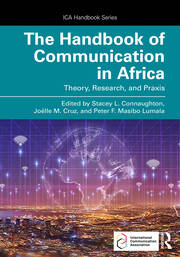
The Handbook of Communication in Africa Theory, Research, and Praxis
Editors’ Introduction: African Communication Studies: A Celebration and a Call for (Further) Action
Stacey L. Connaughton, Joelle M. Cruz, Peter F. Masibo Lumala
Section 1: Metatheoretical Perspectives
1. Africa at a Crossroads: Resisting Power and Unpacking Africa’s Problems and Possibilities through a Post-Positivist Approach
Omotayo O. Banjo, Yewande O. Addie, Olunifesi A. Suraj, and Dirichi Umunna
2. Interpretive Perspectives on Communication in Africa
Rita Daniels
3. Critiquing Colonialism in African Communication Studies
Jenna N. Hanchey
4. Postcolonial and Subaltern Scholarship on Communication in the African Continent: Storytelling, Representation, and Resistance
Tiwaladeoluwa Adekunle, Angela Lasso-Jimenez, Catherine Lopez Barajas, Stacey L. Connaughton
Section 2: Research Areas
5. On Ethiopian Media Studies: Some Initial Musings on an Emerging Scholarly Current
Téwodros W. Workneh
6. Media Veracity and Platform Authenticity: The Case of WhatsApp in Africa
Brian Pindayi
7. Public Relations in the African Context: A Review of Current Scholarship
Meghana Rawat, Temiloluwa Oluwagbotemi Wright, Arunima Krishna
8. Organizational Communication Research in Africa: An Analytical Review
Eric Karikari and Denise D. Duncan
9. An Exploration of Health Communication in Africa: A Systematic Analytic Review
Robert Nyaga and Prince Adu Gyamfi
10. Technology and Communication
L. Jessica Foumena Kempton and Jasmine R. Linabary
11. Communication and Gender Inequality in Africa
Juliet Wambui Macharia
12. Gender, Culture and Media Dynamics in Africa: A Critical Reflection
Peter F. Masibo Lumala
13. Communicating Sport in Africa: A Nascent Field with Expanding Trajectory
Chuka Onwumechili
14. Toward Epistemic Freedom in the Study of Communication in/about/and “the Environment” in Africa
Kundai Chirindo
15. “The Past Still Present”: China-Africa Media Relations and the Transformations in Global Communication
Teke Ngomba
16. AI-Driven Social Media Analysis in Africa: Trends, Misinformation, and Political Discourse
John Z. Arufandika
Section 3: Research and Practice
17. Situating the Catalytic Role of Cellular Technology within the Paradigmatic Shifts of Social Transformation among the Disenfranchised in Sub-Saharan Africa
Geoffrey Kiplimo Korir and Justin C. Nabushawo
18. Media Coverage and Activism Research and Practice in Africa
Osman Osman and j. Siguru Wahutu
19. Communication Law Education in East Africa
Erneo Nyakundi Nyamboga and Levi Obonyo
20. Reflections on Development Communication, Gender, and Health in Africa
Elinam Amevor and H. Leslie Steeves
21. Peacebuilding and Communication in Africa
Ryan N. Funkhouser, Adeola Mobolaji, and Stacey L. Connaughton
22. Communication Research and Human Rights in Africa: Perspectives, Practices and Prospects
Bala A. Musa
23. Naked Protests in Africa: A Critical Reading and Theorizing of African Resistance
Millicent Elewosi, Evans A. Agyapong, and Stanley Karombo
24. Indigenous Voices in the Digital Age: SMS Technologies for Environmental Justice Among Kenya’s Ogiek
Cynthia Klekar Cunningham, Lusike Mukhongo, Autumn Edwards, Chad Edwards, Habeeb Abdulrauf, Abdullah Mohaimen, and Winston Mano
Biography
Stacey L. Connaughton is Professor in the Brian Lamb School of Communication at Purdue University, USA.
Joëlle M. Cruz is Associate Professor in the Department of Communication at the University of Colorado at Boulder, USA.
Peter F. Masibo Lumala is Director of the Institute of Open and Distance E-Learning at Moi University, Kenya.
“The ICA Handbook of Communication in Africa: Theory, Research, and Praxis dispels what Westerners think that they know about Africa. It offers exciting, current examinations of African cosmologies and values, diverse communication contexts, preferred media platforms and uses, ethics and human rights stances, and challenges to Western onto-epistemological worldviews and practices. Chapters show how enduring colonial logics affect every aspect of ordinary lives. Chapters by/for/about Africans call for the expanded presence of Africans in communication and media scholarship not simply as subjects but as researchers and activists promoting indigenous understandings of local communities, nations, and regions of the African continent.”
Patrice M. Buzzanell, University of South Florida, USA and Past President, International Communication Association
“I wholeheartedly endorse this ICA Handbook of Communication in Africa: Theory, Research and Praxis by Stacey L. Connaughton, Joelle M. Cruz, and Peter F. Masibo Lumala for its critical proclamation of African communication studies and its challenge to the homogenising effects of colonisation and modernisation. The Handbook underscores the urgent need to prioritise African identities, advance context-specific communication research, promote gender equality, and critically examine the role of media in shaping Africa’s social and political landscapes. It is a timely and transformative contribution to the global communication field.”
Deborah Auko Tendo, Author of Rough Silk: The Story of Dad and Daughter, and UN Youth Advocacy Writer
“The publication of the ICA Handbook of Communication in Africa: Theory, Research and Praxis marks a watershed in the emergence of African communication scholarship. It assembles a formidable, brilliant, and theoretically sophisticated group of African, Afro-diasporic, and Africanist scholars who write incisively and beautifully across a breathtaking range of fields, regions, and media. By far its most distinctive intervention consists in the way it powerfully centers indigenous African ontological, epistemological, and axiological paradigms. This is a book that ought to be considered mandatory reading not only within the discipline of Communication Studies, but also in disciplines and fields such as anthropology, cultural studies, journalism, media studies, philosophy, political science, sociology, and aesthetics.”
Omedi Ochieng, University of Colorado Boulder, USA
“The ICA Handbook of Communication in Africa is an essential, groundbreaking compendium that advances critical understanding of African communication studies through diverse, innovative perspectives. It expertly bridges theory, research, and praxis, offering invaluable insights for scholars, practitioners, and policymakers committed to transformative social change across the continent. This authoritative volume is a must-have resource for anyone dedicated to elevating African voices and addressing pressing communication challenges.”
Prof. Laban P. Ayiro, Daystar University, Kenya
