





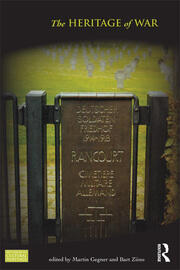
Series general co-editors’ foreword Introduction. The Heritage of War: Agency, Contingency, Identity Martin Gegner and Bart Ziino Part I: Remembering and Representing War 1. Hellfire Pass Memorial Museum, Thai-Burma Railway Joan Beaumont 2. Victory and defeat at Ðiện Biên Phủ: memory and memorialization in Vietnam and France William Logan and Nguyễn Thanh Bình 3. War monuments in East and West Berlin: Cold War symbols or different forms of memorial? Martin Gegner 4. ‘Inevitable erosion of heroes and landmarks’: an end to the politics of Allied war memorials in Tarawa? Judith A. Bennett 5. Commemorating the American Civil War in National Park Service battlefields Robert K. Sutton Part II: Identities 6. ‘Our ancestors the Incas:’ Andean warring over the conquering pasts O. Hugo Benavides 7. ‘We are talking about Gallipoli after all’: contested narratives, contested ownership and the Gallipoli Peninsula Bart Ziino 8. Narrating genocide on the streets of Kigali Stephanie L. McKinney 9. Remembering and forgetting: South Asia and the Second World War Yasmin Khan Part III: The politics of reconstruction 10. Reconstruction over ruins: rebuilding Dresden’s Frauenkirche Tony Joel 11. Symbols of reconstruction, signs of divisions. The case of Mitrovica, Kosovo Frank Schwartze 12. Reconstruction as exclusion: Beirut Esther Charlesworth and Anitra Nelson Index
Biography
Martin Gegner is visiting professor at Universidade de São Paulo, Brazil, and director of the German Academic Exchange Service’s (DAAD) centre in this city. His research interests lie in Politics and Sociology of Urban Heritage, Cultural Theory and Political Philosophy.
Bart Ziino is a lecturer in history at Deakin University, Australia. His research interests include memory and commemoration of war, and private experiences of Australian civilians during the First World War. Recent publications include A Distant Grief: Australians, War Graves and the Great War (2007).
