



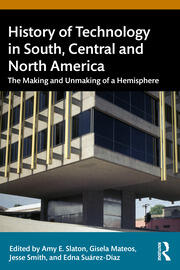

1st Edition
The History of Technology in the Americas The Making and Unmaking of a Hemisphere
Introduction. Section I: Beyond Agency. 1. Movidas Against the Machine. 2. The Making of Productive Citizens: Approaching the Technopolitics of Credit in Latin America. 3. Race, Antiracism, and the History of "American Technology". 4. Engineering, Historical Contingency, and the Pan-American Railroad. 5. Beyond Replicas: Latin America's First Interactive Science Museums 1970-1979. Artifact Report: "The First Africans Who Made Glass in Brazil": Enslaved Labor and Glassmaking in the Early Nineteenth Century. Section II: Beyond Chronology. 6. Cooking vs. Kitchen: A Look into Women's Daily Life. 7. A Social Fabric: Two Sides of American Celanese. 8. Identity Cards. 9. Ibáñez' Roads: Engineering, Planning and Dictatorship in Chile in the 1920s. Artifact Report: Fever as Technology: Notes on the Appropriation of Malaria Therapy in Brazil. Section III: Beyond Borders. 10. The Discovery of Latin America at CEPAL. 11. When All that is Solid Melts: Geographies, Climates, and Technologies in Canada. 12. Migrations of Computing. 13. Rings of Fire II: Arsenic Cycles Through Racism and Empire in the Americas. 14. Designing Tropicality: The Experimental Sugar Plantation and Knowledge in the Global South. Artifact Report: "Eye Dazzlers".
Biography
Amy E. Slaton is Professor Emerita of History, Drexel University, USA. She holds a PhD in the History and Sociology of Science from the University of Pennsylvania and studies ascriptions of human difference in science and engineering as expressed through education, labor practices, and other materializations of race, gender, sexuality and disability.
Gisela Mateos is a Full Professor at UNAM, Mexico. Her interests lie in the history of science, technology, and public health in Mexico and Latin America, and more specifically, the technical assistance programs set up for scientific practices across countries of the so-called Third World between 1950 and 1970.
Jesse Smith is the Vice President of Interpretation and Education, and Director of the Museum, at the Science History Institute, USA, where he oversees exhibitions and other projects in the public history of science. He holds a PhD in the History and Sociology of Science from the University of Pennsylvania.
Edna Suárez Díaz is Full Professor at the National University of Mexico, Mexico, and Research Fellow at the Max Planck Institute for the History of Science in Berlin, Germany. Her work has focused on the history of the life sciences, the history of technology and technical assistance in 20th century Mexico.
