
1st Edition

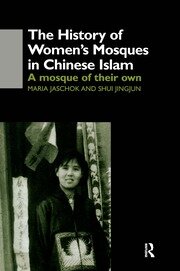
The History of Women's Mosques in Chinese Islam

By Maria Jaschok, Shui Jingjun Shui Copyright 2001
361 Pages
by Routledge

382 Pages
by Routledge

361 Pages
by Routledge

This is a study of Chinese Hui Muslim women's historic and unrelenting spiritual, educational, political and gendered drive for an institutional presence in Islamic worship and leadership: 'a mosque of one's own' as a unique feature of Chinese Muslim culture. The authors place the historical origin of women's segregated religious institutions in the Chinese Islamic diaspora's fight for survival,... Read more
Acknowledgements, Division of Labour, List of Maps and Tables, Illustrations, Abbreviations, Collective Preface, PAR T I: Introduction, PAR TIl: From the Margins of Memory, PAR T II I: Women's Mosques, Nu Ahong and their Religious Culture, PART IV: Claiming Heaven, PART V: Chinese Muslim Women: Communitas, Choices, and Conversion, Appendix I Profiles of Two Leading Women's Mosques and their Religious Leadership, Appendix II Nusi in the Repuhlican Era (1912-1949), Appendix III Questioning Hui and Han Women and Men on Quality of Life (Survey), Appendix IV Unpublished Documentation on Central China's Muslim Culture and Women's Lives (lodged with Henan Provincial Library, Zhengzhou, Henan Province), Glossary, Bibliography, Index

Biography

Shui Jingjun Shui, Maria Jaschok

'Unique in several ways ... a wonderful and fascinating book.' - Arab Studies Journal

'It represents a thoroughly researched treatment of a complex topic and provides a wealth of material for anyone interested in the history of Islam in China. By offering stimulating and thought-provoking viewpoints, it establishes a valuable foundation for future research.' - Journal of the Royal Asiatic Society

'Maria Jaschok and Shui Jingjun’s The History of Women’s Mosques in Chinese Islam: A Mosque of Their Own tells the little-known story of one of the most fascinating developments in the history of Muslims in China: mosques run exclusively by women for women, known in Chinese as nüsi...A Mosque of Their Own provides a richly contextualized view of this unique history in which ethnoreligious minority identity and gender issues overlap.' - Religious Studies Review
