





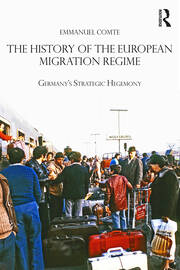
1st Edition
The History of the European Migration Regime Germany's Strategic Hegemony
Illustrations
Abbreviations
Introduction
1. An unstable regime, 1947–1954
2. A new regime taking shape, 1955–1964
3. A shrinking dynamic, 1965–1973
4. A protectionist status quo, 1973–1984
5. A selective and regionalist regime, 1984–1992
Conclusion
Acknowledgments
Sources
Biography
Emmanuel Comte is a Senior Research Fellow at CIDOB, Barcelona.
"In this illuminating and timely book, … Emmanuel Comte details the nearly half-century history of how Europe’s regime of internal open borders came into existence. … This book is a significant achievement. It adds a much-needed "European" dimension to a historiography that has mostly told national stories. … This book will be read with great profit by migration historians and scholars of European integration." - Christopher A. Molnar, University of Michigan–Flint, American Historical Review
"The French historian, who has taught and worked since his doctorate at Berkeley, the EUI in Florence and most recently at the Diplomatic Academy in Vienna, shows what intensive and protracted political efforts it took to establish a European Union without internal borders. ... Comte's book is ground-breaking in a very relevant field of European integration, and most recently, disintegration." - Philipp Ther, University of Vienna, Journal of European Integration History
"The book provides a solid foundation in the history of immigration policy in Europe during a crucial period, and is recommended for those studying this region and the historical antecedents of today’s policy environment." - Christopher L. Atkinson, University of West Florida
"The historical survey remains remarkably succinct and balances its attention between national and international policymaking. Appropriately, the primary sources reflect deep archival research at both levels, and Comte must be commended for collating sources from across multiple languages. Particularly for social scientists that often synthesise the primary research of others, this book offers a rich body of information and analysis uniting national politics and economics within a dynamic framework that traces the emergence of European governance of migration." - Alexander Caviedes, State University of New York
"The book is an important intervention in its move beyond the national level." - Jennifer Miller, Southern Illinois University Edwardsville
"Comte succeeds in the daunting task of delivering a clear argument based on more than 40 years of history without getting lost in pluri-annual archival research, undertaken in multiple languages. His book represents an important contribution to the existing literature as an easy-to-read text fit for a wide audience of both academic scholars and policymakers interested in how and to what extent the current European migration regime was shaped by German influence and which other underlying national interests it came to represent over time." - Maria Chiara Vinciguerra, University of Cambridge
"This book offers a well-researched and rich political history of how the open migration regime within Europe formed." - Melissa Schnyder, American Public University
