





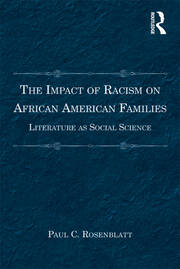
1st Edition
The Impact of Racism on African American Families Literature as Social Science
By Paul C. Rosenblatt
Copyright 2014
192 Pages
by
Routledge
192 Pages
by
Routledge
192 Pages
by
Routledge
Also available as eBook on:
In spite of the existence of statistics and numerical data on various aspects of African American life, including housing, earnings, assets, unemployment, household violence, teen pregnancy and encounters with the criminal justice system, social science literature on how racism affects the everyday interactions of African American families is limited. How does racism come home to and affect... Read more
The Impact of Racism on African American Families
Biography
Paul C. Rosenblatt is Professor Emeritus of Family Social Science at the University of Minnesota, USA. He is the author of Shared Obliviousness in Family Systems and Two in a Bed: The Social System of Couple Bed Sharing and co-author of Knowing and Not Knowing in Intimate Relationships, African American Grief and Multiracial Couples: Black and White Voices.
’... the strength of this project is its ability to document how individual experiences of racism have correlating impacts on the family system. Of particular interest are the discussions of the impact of racism on communication within the family and on parenting. Recommended.’ Choice ’This text is a powerful exploration of the private world of African American families. Race and racism are challenging topics and difficult to address in traditional research approaches. Here, the experiences of characters in novels by well-respected African American authors are examined through the lens of family systems theory, deepening our understanding beyond what we can learn from traditional approaches.’ Kathleen R. Gilbert, Indiana University, USA ’Rosenblatt’s innovative, illuminating thematic analysis compellingly synthesizes family systems social science, critical race theory, qualitative research, and narrative analysis. Building on a long career studying family responses to adversity, Rosenblatt’s indispensable text inspiringly challenges academic boundaries and societal barriers that have made every-day racism and its consequences invisible outside of African American communities, offering a foundation for actualizing change.’ Ester Shapiro, University of Massachusetts at Boston, USA
