





1st Edition
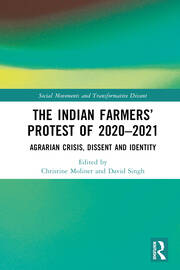
The Indian Farmers’ Protest of 2020–2021 Agrarian Crisis, Dissent and Identity
Chapter 1. Introduction
Christine Moliner and David Singh
Part I. The Agrarian Question and the Farmers’ Movement in Neoliberal Times
Chapter 2. Farming Laws: BJP’s Strategic Vision of Strengthening Agro-business Capitalism and Hindu Nationalism
Pritam Singh
Chapter 3. India’s Farmers’ Movement and the ‘Agrarian Questions’: Authoritarian Populism versus Agrarian Populism
Subir Sinha
Chapter 4. The Kisan Andolan and India’s Roll-Over Neoliberalism
Kenneth Bo Nielsen and Alf Gunvald Nilsen
Part II. Agrarian Capitalism in Punjab
Chapter 5. Sikhi Idiom and the Making of the Punjabi Farmers’ Movement of 2020–2021
Surinder S. Jodhka
Chapter 6. The Political Economy of the Farmers’ Protest: Emerging Perspectives from the Field
Gaurav Bansal
Chapter 7. Punjab’s Mandis, Agrarian Life and the Farmers’ Protest
Shreya Sinha
Part III. The Farmers’ Protest and Intersectionality: Caste, Class, and Gender
Chapter 8. The Farmers’ Movement and New Agrarian Politics in Northern India (2020–2021)
Satendra Kumar
Chapter 9. When Women Farmers Protest Patriarchy and Capitalism
Floriane Bolazzi, Kaveri Haritas and Isabelle Guérin
Chapter 10. Bodily Strategies in the Kisan Andolan
Ananya Bhuyan
Part IV: Identity and Radical Politics in the Kisan Andolan
Chapter 11. Kisan Andolan Dee Vaar (The Ballad of the Farmers’ Movement): Poetics of Resistance in the Kisan Morcha
Virinder Kalra
Chapter 12. The Indian Farmers’ Protest, 2020–2021: Historical Antecedents of Contradictory Ideologies and New Alliances
Virinder Kalra
Chapter 13. ‘It is Baba Nanak Who Is Running This Protest’: The Role of Sikhi in the Kisan Andolan
Christine Moliner
Part V. From the Ground: Voices, Testimonies and Interviews
Chapter 14. The Protest: A Battle of Media Narratives
Amandeep Sandhu and Gurshamshir Singh Waraich
Chapter 15. Voices from the Andolan: Interviews with Union Leaders and Activists
Sakshi Chindaliya, Deepanshu Mohan, Jignesh Mistry and Siddharth G.
Chapter 16. The Importance of Organising: Interview with Nodeep Kaur
Aashita Dawer
Chapter 17. The Dalit Perspective: Interview with Lachhman Singh Sewewala
Christine Moliner
Chapter 18. Learning from the Legacy of the Farmers’ Movement
Shivam Mogha
Biography
Christine Moliner is a social anthropologist and an associate professor at O.P. Jindal Global University (India). Her research and publications have focused on the Sikh Diaspora in Europe, the link between the agrarian crisis and international mobility from Punjab, Sikh minority status and Sikh responses to Hindu majoritarianism both in India and in the West.
David Singh is a postdoctoral researcher at the University of Copenhagen (Denmark). His research interests focus on land politics, resource extraction and green energy infrastructures, the making of citizenship and nations from a political ecology and critical agrarian studies perspective. David’s Ph.D. dissertation discussed the issue of mediation and caste power in fixing large-scale wind power projects, the reconfiguration of space by identity politics and Hindu nationalism and the emergence of diverse resistance practices. David Singh has published in Contemporary South Asia, Journal of Political Ecology and Journal of Contemporary Asia.
‘Perhaps we shall never fully understand what happened in those heady days of 2020-21, when hundreds of thousands of Indian farmers assembled in Delhi, set up some of the most vibrant protest sites India had ever seen, and eventually forced the Modi government to repeal its corporate-sponsored farm laws. This insightful collection of essays and testimonies sheds new light on these events from different angles. It is an invaluable retrospective on one of the most inspiring social movements of our time.’
Jean Drèze, visiting Professor at the Department of Economics, Ranchi University
‘This impressive collection offers the most comprehensive analysis to date of India’s historic farmer protests. Bringing together leading scholars of rural India and drawing productively on the tradition of agrarian political economy, it provides not only a thorough documentation of the movement but insightful analyses of its causes and consequences. A must-read not only for students of rural India but for all those interested in the neoliberalisation of agriculture and agrarian social movements.’
Michael Levien, Professor, Department of Sociology, Johns Hopkins University
‘This edited volume does not only tell a story that had to be registered, but also deciphers the farmers’ protest movement of 2020-21 by exploring all its facettes, including its sociological dimensions in terms of class, caste, religion and gender. Comprehensive and analytical, it is bound to become the reference book on one of the most massive - and still understudied - act of ideological and social resistance to the rise of agro-business in today’s India.’
Christophe Jaffrelot, Professor, Sciences Po Paris and King’s College London
‘A rich, kaleidoscopic overview of one of the most significant protest movements in India in recent memory. This thought-provoking volume provides important insights, from aspects of the actual struggle with its diverse means and actors, to underlying trajectories and wider consequences of the mobilisation against the farm laws.’
Jens Lerche, Emeritus Professor, SOAS London
