





1st Edition
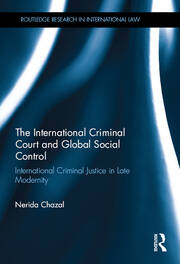
The International Criminal Court and Global Social Control International Criminal Justice in Late Modernity
1. Introduction 2. The Development and Aims of the International Criminal Court 3. Tensions between Ideal and Reality in the Pursuit of Justice 4. Late Modernity, Social Control and the ICC 5. The Role of Actors in Shaping the ICC 6. The Trial as a Site of Contest: The DRC and Thomas Lubanga 7. The ICC as a Tool 8. Conclusion: The Resilience of the ICC and International Criminal Justice in Late Modernity
Biography
Nerida Chazal is a Lecturer in Criminology at Flinders University, Australia. Her research examines the aims and functioning of international criminal justice in a complex and increasingly global world. Nerida has previously worked as a Research Fellow with the Centre for Crime Policy and Research at Flinders University. She is co-editor (with W. De Lint and M. Marmo) of Criminal Justice in International Society (Routledge, 2014), and co-author (with M. Marmo) of Transnational Crime and Criminal Justice (Sage, 2016).
"At its genesis, the International Criminal Court was expected to help prevent atrocities by ending the impunity of leaders and administering punishment for the commission of international crimes. More than a decade later, the ICC’s ability to achieve these broad aims has been questioned, as the ICC has reached only two guilty verdicts, and the United States, Russia, and China have not joined. Chazal considers how gaps between rhetoric and reality arise in
the work of the ICC, and concludes that these can be productive as they enable the Court to navigate a complex, international environment driven by geopolitics."
Law and Social Inquiry Journal
