




1st Edition
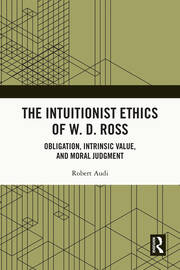
The Intuitionist Ethics of W. D. Ross Obligation, Intrinsic Value, and Moral Judgment
Introduction
Part I: Ross’s Comprehensive Theory of Obligation: Metaethics, Epistemology, and Standards of Duty
Chapter 1: Semantic, Conceptual, and Epistemological Preliminaries
Chapter 2: The Grounds and Scope of Moral Obligation
Chapter 3: The Determination of Final Obligation
Chapter 4: Self-Evidence and General Moral Knowledge
Chapter 5: The Metaphysics of Rossian Intuitionism
Chapter 6: The Scope and Limits of the Duty of Beneficence
Part II: Ross’s Theories of Value and Moral Creditworthiness
Chapter 7: The Concept of Intrinsic Goodness
Chapter 8: Ross’s Fourfold Taxonomy of the Intrinsically Good
Chapter 9: The Measurability of Intrinsic Goodness
Chapter 10: Moral Goodness, Moral Creditworthiness, and Virtue
Part III: Challenges and Extensions
Chapter 11: The Comprehensiveness of Ross’s Axiological Resources
Chapter 12: Unifying Elements in Rossian Intuitionism
Conclusion
References
Biography
Robert Audi is an internationally distinguished philosopher and author of numerous papers and many books spanning ethics and political philosophy, epistemology, the theory of human action, and the philosophy of religion. He is a past president of the American Philosophical Association, Fellow of the American Academy of Arts and Sciences, and currently John A. O’Brien Professor of Philosophy, University of Notre Dame.
“Ross’s ethical intuitionism unites a rationalist moral epistemology with a robust pluralism in normative ethics, positioning his view as a major alternative to Kantian, utilitarian, and virtue-ethical theories. Robert Audi’s book is a landmark study of Ross’s ethics, elucidating its central elements and situating them within contemporary debates on obligation, value, intuition, reflective equilibrium, pluralism, and more. As characteristic of Audi’s work, the book is rigorous, full of examples, and engagingly written. Beyond its significance for scholars in ethics and related fields, this volume is well-suited for use in advanced undergraduate and graduate courses.” – Mark Timmons, University of Arizona, USA.
“Robert Audi’s new book on W. D. Ross’s moral philosophy is both the most comprehensive discussion of Ross’s ethics yet and a captivating development of Rossian intuitionism and deontological pluralism. Audi also presents important new arguments concerning moral epistemology, moral ontology, moral psychology, the theory of value, and the plural grounds of moral rightness. Everyone interested in cutting-edge meta-ethics and normative ethical theory should read this book.” – Brad Hooker, University of Reading, UK.
“This book is an impressive statement of how to do moral philosophy by engaging in the history of philosophical ideas in ethics, showing their vibrancy and sustained applicability. With his characteristic analytic acuity, Audi expounds the lasting achievements of W. D. Ross’s ethics, which uniquely combines prima facie duties entrenched in non-parochial common-sense convictions with bottom-up moral reasoning. Exploring the complexities of Rossian intuitionism, including a nuanced discussion of objections levelled against it, Audi convincingly presents it as a powerful current option for doing ethics. Robert Audi at his best.” – Sonja Rinofner, University of Graz, Austria.
“Robert Audi is among the most respected and influential philosophers of our time, and his work has shaped contemporary debates in ethics, epistemology, and political philosophy. This book reflects the clarity, rigour, and intellectual breadth that characterise his works, combining systematic argument with philosophical depth. This excellent and unique monograph offers a timely and much-needed study of one of the most influential yet often underappreciated moral philosophers of the twentieth century. It illuminates the depth and contemporary relevance of Rossian intuitionism, clarifying its distinctive account of moral knowledge, pluralistic duties, and practical reasoning. It will be indispensable for scholars of normative ethics and moral theory. It is an authoritative and highly valuable contribution that will reward both academics and serious students of philosophy.”– Marta Soniewicka, Jagiellonian University, Krakow, Poland.
