




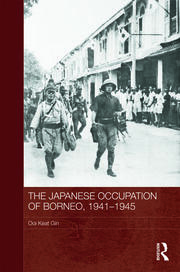
1. Introduction 2. Prewar Borneo 3. On the Road to War 4. The Japanese Invasion and Occupation of Bornoe 5. The Partition of Borneo 6. Kita Boruneo 7. Minami Boruneo 8. Opposition and Response 9. Between Generals and Admirals 10. End of a Era 11. Concluding Remarks
Biography
Ooi Keat Gin is Professor of History in the School of Humanities, Universiti Sains Malaysia, Penang, Malaysia. He is also a Fellow of the Royal Historical Society (London, UK) and formerly of the Faculty of Politics and International Studies, University of Hull (Hull, UK). He is the author of numerous books and articles, including World beyond the Rivers (1996) and From Colonial Outpost to Cosmopolitan Centre (2002). He is the editor of the critically acclaimed Southeast Asia: A Historical Encyclopedia, 3 vols. (ABC-Clio, 2004). He is also the chief editor of the International Journal of Asia-Pacific Studies (IJAPS) and serves as series editor of the APRU-USM Asia Pacific Studies Publications Series (AAPSPS).
"Known for editing a landmark encyclopedia on Southeast Asia, in this work Ooi Keat Gin focuses upon a specific place at a specific time, namely the Japanese wartime occupation of the island of Borneo... To his great merit, Ooi has written one of the best recent detailed studies on the occupation of one part of Southeast Asia, drawing upon a wealth of research and revealing great skill in handling archival sources as well as making sense of this sorry episode in modern history." - Geoffrey Gunn, Nagasaki University; Journal of Contemporary Asia, 43:2, 379-381
