




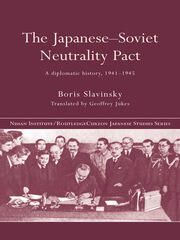
1st Edition
The Japanese-Soviet Neutrality Pact A Diplomatic History 1941-1945
By Boris Slavinsky
Copyright 2003
252 Pages
by
Routledge
252 Pages
by
Routledge
Also available as eBook on:
The neutrality pact between Japan and the Soviet Union, signed in April 1941, lapsed only nine months before its expiry date of April 1946 when the Soviet Union attacked Japan. Japan's neutrality had enabled Stalin to move Far Eastern forces to the German front where they contributed significantly to Soviet victories from Moscow to Berlin. Slavinsky suggests that Stalin's agreement with Churchill... Read more
1. Historiography of the Problem 2. Non-Aggression Pact or Neutrality Pact? 3. Matsuoka's Negotiations in Moscow, Signing and Evaluation of the Neutrality Pact 4. Germany's Attack on the USSR and Japan's Position 5. Japan's Pearl Harbour Attack and the Neutrality Pact 6. The Neutrality Pact during Japan's Period of Success in the East Asian War 1941-42 7. Implementing the Neutrality Pact, 1943 to mid 1944: Problems and Achievements 8. The Last Year of the USSR's War with Germany 9. The Denunciation of the Neutrality Pact 10. Japan Seeks Soviet Mediation, May-July 1945 11. The USSR joins the War against Japan Afterword. Endnotes
Biography
Boris Slavinsky spent many years researching Soviet foreign and defense policies in service of the British government which led him to later undertake academic research in the subject. He specialized in Russian/Soviet military history and policies towards the Asia Pacific region and was studying the Russian Far East shortly before he died.
Geoffrey Jukes is now retired but was formally an Associate Fellow of the Australian National University.
'Stavinsky's significant volume appears in English for the first time. His work will continue to be referenced as an important bibliography, and to inspire future generations of academics.' - Kimie Hara, Department of Political Science, University of Calgary
