




1st Edition
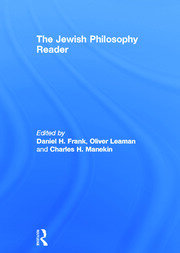
The Jewish Philosophy Reader
640 Pages
by
Routledge
640 Pages
by
Routledge
The Jewish Philosophy Reader is the first comprehensive anthology of classic writings on Jewish philosophy from the Bible to the present. Complementing the History of Jewish Philosophy (Routledge, 1997), the Reader is divided into four parts: * Foundations and First Principles * Medieval and Renaissance Jewish Philosophy * Modern Jewish Thought * Contemporary Jewish Philosophy Each section... Read more
Preface I Foundations and First Principles, The Bible and Philosophical Exegesis 1 Creation: Divine Power and Human Freedom 2 The Aqedah (The Binding of Isaac): Divine Commandments and Moral Duties 3 ‘Hardening of Hearts’: On Free Will and Repentance 4 Job and Divine Providence 5 Justice 6 Prayer and Faith 7 Free Will and Divine Foreknowledge 8 Election 9 Law and Rationality 10 Issues of Meaning II Medieval and Renaissance Jewish Philosophy 11 Jewish Kala¯m 12 Jewish Neoplatonism 13 Judah Halevi and Abraham Ibn Ezra 14 Maimonides 15 Jewish Aristotelianism in Spain and Provence 16 The Conservative Reaction in Christian Spain 17 Jewish Philosophy in the Italian Renaissance III Modern Jewish Thought: Between History and Tradition 18 A Critique of Traditional Religion 19 Judaism and the Enlightenment 20 Scholarship and Religious Reform 21 The Authority of Tradition 22 Revelation, Redemption, and the Nature of Judaism IV Contemporary Jewish Philosophy 23 Immortality and Messianism 24 Other Faiths 25 Prophecy and the Community 26 Rationalism 27 Evil and Suffering 28 Issues of Inclusion 29 Election and Covenant 30 Holocaust 31 The State of Israel/Zionism 32 Reason and Faith 33 Belief
Biography
Dan Frank is Professor of Philosophy, University of Kentucky, Oliver Leaman is Lecturer in Philosophy at Liverpool John Moores University and Charles Manekin is Professor of Philosophy, University of Maryland.
'This is an immensely wide-ranging anthology, covering all the great themes of Jewish reflection and spanning the eras from biblical texts through the medieval Jewish philosophers to modern times. I have no doubt that it will quickly become the standard text for courses on the history of Jewish thought.' - Jonathan Sacks, Jewish Chronicle
