




1st Edition
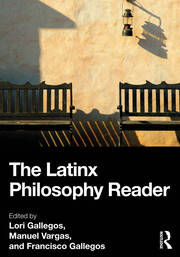
The Latinx Philosophy Reader
Introduction
Part 1. Social Identity
Introduction
1. Alcoff, Linda Martín (2000) “Is Latina/o Identity a Racial Identity?”
2. Gracia, Jorge J. E. (2008) “Identities: General and Particular” (excerpts)
3. Dussel, Enrique (2009) “Being-in-the-World-Hispanically: A World on the 'Border' of Many Worlds”
4. Gonzalez de Allen, Gertrude (2012) “From the Caribbean to the U.S.: Afro-Latinity in Changing Contexts”
5. Barceló Aspeitia, Axel Arturo (2020) “Open Questions in the Metaphysics of Habitable Categories”
Part 2. Mestizaje and Indigeneity
Introduction
6. Vasconcelos, José (1925) “Mestizaje” (Preface to The Cosmic Race)
7. Forbes, Jack D. (1973) “The Mestizo Concept: A Product of European Imperialism”
8. Anzaldúa, Gloria (1987) “La Conciencia de la Mestiza: Towards a New Consciousness”
9. Pulido, Laura (2017) “Geographies of Race and Ethnicity III: Settler Colonialism and Nonnative People of Color”
10. Pitts, Andrea J. (commissioned) “Mestizaje, Métissage, and Mixedblood: Tracing Some Political Terms of Racial and Cultural Mixture Across the Americas”
Part 3. Cross-Cultural Challenges
Editorial introduction
11. Alcoff, Linda Martín (1999) “Latina/o Identity Politics”
12. Lugones, Maria (1987) “Playfulness, ‘World’-Traveling, and Loving Perception”
13. Barvosa, Edwina (2007). “Mestiza Autonomy as Relational Autonomy: Ambivalence and the Social Character of Free Will”
14. Morton, Jennifer M. (2014) “Cultural Code-Switching: Straddling the Achievement Gap”
15. Vargas, Manuel (2020) “The Philosophy of Accidentality”
Part 4. Phenomenology, Hermeneutics, and Coloniality
Introduction
16. María Lugones, “Heterosexualism and the Colonial/Modern Gender System” (2007)
17. Isasi-Díaz, Ada María (2011) “Mujerista Discourse: A Platform for Latinas’ Subjugated Knowledge”
18. Ortega, Mariana (2016) “Hometactics: Everyday Practices of Multiplicitous Selves”
19. Ruiz, Elena Flores (2020) “Between Hermeneutic Violence and Alphabets of Survival”
20. Méndez, Xhercis (2020) “Decolonial Feminist Movidas: A Caribeña (Re)thinks ‘Privilege,’ the Wages of Gender, and Building Complex Coalitions”
Part 5. Language and Communication
Introduction
21. Anzaldúa, Gloria (1987) “How to Tame a Wild Tongue”
22. Gallegos, Lori (2021) “The Interpreter’s Dilemma: On the Moral Burden of Consensual Heteronomy”
23. Schutte, Ofelia (1998) “Cultural Alterity: Cross-Cultural Communication and Feminist Theory in North-South Contexts”
24. Millán, Elizabeth (2012) “Language, Power, and Philosophy: Some Comments on the Exclusion of Spanish from the Philosophical Canon”
Part 6. Immigration and Citizenship
Introduction
25. Mendieta, Eduardo (1999) “Becoming Citizens, Becoming Latinos”
26. Orosco, José-Antonio (2016) “Cesar Chavez and the Pluralist Foundations of US Democracy”
27. Mendoza, José Jorge (commissioned) “The Latinx Racial Disintegration Thesis: Whiteness, Democracy, and Latinx Identity”
28. Reed-Sandoval, Amy (2020) “Socially, Not Legally, Undocumented”
29. Mendieta, Eduardo (2021) “Jus Sanguinis vs. Jus Soli: On the Grounds of Justice”
30. Wolf, Allison B. “The Gendered Nature of U.S. Immigration Policy”
Part 7. Metaphilosophy
Introduction
31. Atencio, Tomás (2009) “Oro del Barrio in the Cyber Age: Leapfrogging the Industrial Revolution” (excerpts)
32. Orosco, José-Antonio (2016) “The Philosophical Gift of Brown Folks: Mexican American Philosophy in the United States”
33. Sánchez, Carlos Alberto. (2016) “Philosophy sin más?: Notes on the Value of Mexican Philosophy for Latino/a Life” (excerpts)
34. Madva, Alex (2016) “Implicit Bias and Latinxs in Philosophy”
35. Maldonado-Torres, Nelson (2021) “Notes on Decolonizing Philosophy: Against Epistemic Extractivism and Toward the Abolition of the Canon”
Biography
Lori Gallegos is Associate Professor of Philosophy at Texas State University and the editor of APA Studies on Hispanic/Latino Issues in Philosophy. She works in the areas of Latinx philosophy and the philosophy of emotions, and her publications have appeared in edited volumes and in journals including Hypatia, Philosophical Topics, Journal of Intercultural Studies, Critical Philosophy of Race, Topoi, and the Inter-American Journal of Philosophy.
Manuel Vargas is Professor of Philosophy at the University of California San Diego and the author of Building Better Beings: A Theory of Moral Responsibility (2013); Mexican Philosophy (forthcoming), and a co-author of Four Views on Free Will, 2nd Ed. (2024). He has been the recipient of multiple prizes from the American Philosophical Association, including its Book Prize, Prize in Latin American Thoughts, and the Alvin Plantinga Prize.
Francisco Gallegos is Associate Professor of Philosophy at Wake Forest University. He works on the politics of emotion, Latin American philosophy, Latinx philosophy, and existential phenomenology. He is the co-author of The Disintegration of Community: The Social and Political Philosophy of Jorge Portilla (with Carlos Sánchez, 2020).
"The Latinx Philosophy Reader is a welcome resource for anyone interested in the recent development and current state of the field. This thoughtfully curated collection will provide students with important introductions to how thinkers have wrestled with concepts like identity, coloniality, culture, agency, and epistemology—with U.S. Latines in mind. Established scholars, on the other hand, will appreciate having these crucial defining texts compiled in a single volume. This book offers the already familiar and the newly curious an invitation to dive into some of the most generative and exciting scholarly conversations of recent decades."
—Michael Hames-García, Professor of Mexican American and Latina/o Studies and Interim Director of the Latino Research Institute at the University of Texas at Austin, USA
