




1st Edition
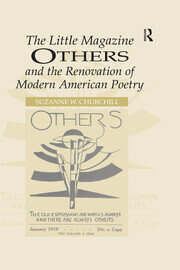
The Little Magazine Others and the Renovation of Modern American Poetry
By Suzanne W. Churchill
Copyright 2006
304 Pages
by
Routledge
304 Pages
by
Routledge
Also available as eBook on:
Suzanne Churchill's well-researched and superbly crafted study is the first book-length treatment of Others, an important and neglected little magazine that served as a laboratory for modernist poetic experimentation. In discussions of influential poets such as Mina Loy, Marianne Moore, and William Carlos Williams, whose careers Others helped launch, Churchill counters the notion of Modernism as... Read more
Contents: Housing Modernism: Little Magazines and the American Free Verse Movement; Making Space for Others; Interior Designs in Others; William Carlos Williams: The Poetics of Ending; Marianne Moore: The Poetics of 'Conversity'; Mina Loy: The Poetics of Dislodging; Appendices; Bibliography; Index.
Biography
Suzanne W. Churchill is Associate Professor of English at Davidson College, USA. She is co-editing a collection of essays on Modernism and little magazines, portions of which were published in a special issue of American Periodicals.
'This fascinating book significantly advances our understanding of modernist poetry and where it came from. Suzanne Churchill chronicles a remarkable episode from literary history with shrewd critical intelligence and thorough scholarship.' David Chinitz, Loyola University Chicago, and author of T. S. Eliot and the Cultural Divide '[Suzanne W. Churchill] has made a valiant attempt to invigorate life into the origins and significance Others' contribution to the American free verse debate movement... Churchill weaves into her text an intricate theoretical perspective infused with the exploration of the role of gender, sexuality and the poetics of space in shaping the Others literary and semantic environment... Churchill's research is exhaustive... usefully appends a full list of contents, authors, editors and publishers which adds value for future researchers. Like the original editors of Others, Churchill has given us a series of 'other' theoretical perspectives which amply illustrate the literary and cultural value of one of the most important little mags published in the trenches of the first generation of free verse wars.' Sharp News
