




1st Edition
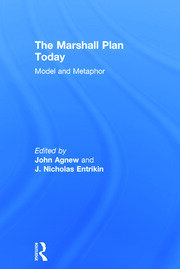
The Marshall Plan Today Model and Metaphor
304 Pages
by
Routledge
304 Pages
by
Routledge
304 Pages
by
Routledge
Also available as eBook on:
This volume has as its focus the role of the Marshall Plan as both a force in the transformation of European Economic practices and a stimulus to political integration in Europe. This organizing theme is framed in terms of two other issues that are central to contemporary debates in international political economy and geopolitical studies: the origins and development of the Cold War, and the... Read more
List of illustrations, Contributors, Foreword: The Marshall Plan Speech, Preface, List of Abbreviations, Introduction: The Marshall Plan as Model and Metaphor, Part I: European Recovery, 1. Post-World War II western European Exceptionalism: The Economic Dimension, 2. Europe and the Marshall Plan: 50 Years On, 3. The Economic Effects of the Marshall Plan Revisited, 4. The Marshall Plan and European Integration: Limits of an Ambition, Part II: Markets and National Policy, 5. As the Twig is Bent: The Marshall Plan in Europe’s Industrial Structure, 6. Confronting the Marshall Plan: US Business and European Recovery, 7. The Marshall Plan: Searching for ‘Creative Peace’ Then and Now, Part III: International Cooperation and Globalization, 8. The Marshall Plan and European Unification: Impulses and Restraints, 9. The Marshall Plan: a Model for What?, 10. From Marshall Plan to Washington Consensus? Globalization, Democratization, and ‘National’ Economic Planning, Index
Biography
John Agnew is Professor and Chair of Geography at UCLA, and past Associate Director of the UCLA Center for European and Russian Studies. Author of many books, his previous publications include: Political Geography; The United States and the World Economy; and Mastering Space (also published by Routledge). J. Nicholas Entrikin is Professor of Geography at UCLA, and past Associate Professor of the Center for European and Russian Studies. His previous publications include: The Betweenness of Place: Towards a Geography of Modernity; and Political Community, Identity and Cosmopolitan Place.
