





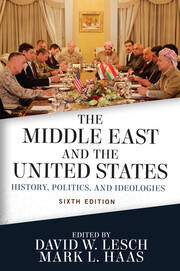
6th Edition
The Middle East and the United States History, Politics, and Ideologies
Introduction: How American Middle East Policy is Made, William B. Quandt
Part I: The US Enters the Middle East
1. Americans and the Muslim World: First Encounters, Robert J. Allison
2. The Ironic Legacy of the King-Crane Commission, James Gelvin
3. US Foreign Policy Toward Iran During the Mussadiq Era, Mark Gasiorowski
4. National Security Concerns in US Policy Toward Egypt, 1949-1956, Peter Hahn
Part II: Cold War Rivalries
5. The 1957 American-Syrian Crisis: Globalist Policy in a Regional Reality, David W. Lesch
6. The United States and Nasserist Pan-Arabism, Malik Mufti
7. The Soviet Perception of the US Threat, Georgiy Mirsky
8. The Superpowers and the Cold War in the Middle East, Rashid Khalidi
Part III: Arab-Israeli War and Peace
9. The 1967 Arab-Israeli War: US Actions and Arab Perceptions, Fawaz A. Gerges
10. The Golan Negotiations: US-Syrian Relations and the Failure to Achieve a Comprehensive Peace, Andrew Bowen
11. From Madrid and Oslo to Camp David: The United States and the Arab-Israeli Conflict, 1991-2001, Jeremy Pressman
12. George W. Bush, Barack Obama, and the Arab-Israeli Conflict, Robert Freedman
Part IV: The Persian Gulf in US Policy
13. The United States in the Persian Gulf: From Twin Pillars to Dual Containment, Gary Sick
14. The Iraq War of 2003: Why Did the United States Decide to Invade?, Steve A. Yetiv
15. What Went Wrong in Iraq?, Ali R. Abootlalebi
16. The United States and Saudi Arabia, Thomas Lippman
Part V: US-Middle Eastern Relations after 9/11
17. Islamist Perceptions of US Policy in the Middle East, Yvonne Yasbeck-Haddad
18. Ideology and America’s Nuclear Crisis with Iran, Mark L. Haas
19. The U.S.’s Post-9/11 Fight against al-Qaeda and the Islamic State: A Losing Effort in Search of a Change, Daveed Gartenstein-Ross
20. The Push and Pull of Strategic Cooperation: The US Relationship with Turkey in the Middle East, Henri J. Barkey
21. The Arab Uprisings from the US Perspective, Mark L. Haas
Epilogue: The Early Years of the Trump Administration’s Middle East Policy, David W. Lesch and Mark L. Haas
Biography
David W. Lesch is the Ewing Halsell Distinguished Professor of History at Trinity University. He is the author or editor of fourteen books, including Syria: The Fall of the House of Assad, The Arab-Israeli Conflict: A History, and The Arab Spring: The Hope and Reality of the Uprisings (with Mark L. Haas).
Mark L. Haas is the Raymond J. Kelley Endowed Chair in International Relations and professor in the Political Science Department at Duquesne University in Pittsburgh. He is the author of The Clash of Ideologies: Middle Eastern Politics and American Security and The Ideological Origins of Great Power Politics, 1789–1989, and coeditor of The Arab Spring (with David W. Lesch).
