





1st Edition
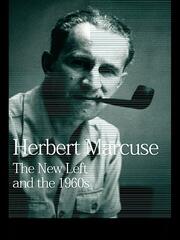
The New Left and the 1960s Collected Papers of Herbert Marcuse, Volume 3
224 Pages
by
Routledge
224 Pages
by
Routledge
224 Pages
by
Routledge
Also available as eBook on:
The New Left and the 1960s is the third volume of Herbert Marcuse's collected papers. In 1964, Marcuse published a major study of advanced industrial society, One Dimensional Man , which was an important influence on the young radicals who formed the New Left. Marcuse embodied many of the defining political impulses of the New Left in his thought and politics - hence a younger generation of... Read more
Preface, Marcuse’s Legacies, Introduction Radical Politics, Marcuse, and the New Left, I Interventions, The Inner Logic of American Policy in Vietnam, Reflections on the French Revolution, Student Protest is Nonviolent Next to the Society Itself, Charles Reich – A Negative View, Dear Angela, Reflections on Calley, Israel is Strong Enough to Concede II The Problem of Violence and the Radical Opposition III Liberation from the Affluent Society IV Democracy Has/Hasn’t a Future . . . a Present V Marcuse Defines his New Left Line VI Testimonies Herbert Marcuse on Czechoslovakia and Vietnam The University of California at San Diego Department of Philosophy on Herbert Marcuse T.W. Adorno on Herbert Marcuse VII On the New Left VIII Mr. Harold Keen: Interview with Dr. Herbert Marcuse IX USA: Questions of Organization and the Revolutionary Subject: A Conversation with Hans Magnus Enzensberger X The Movement in a New Era of Repression: An Assessment XI Bill Moyers: A Conversation with Herbert MarcuseXII Marxism and Feminism XIII 1970s Interventions, Ecology and Revolution, Murder is not a Political Weapon, Thoughts on Judaism, Israel, etc. XIV The Failure of the New Left? Afterword Marcuse’s Cognitive Interest: A Personal View
Biography
Douglas Kellner Is Professor of Philosophy at the University of Texas at Austin.
'Marcuse brought a forceful clarity to the leftist table, a classical Marxism willing to confront new realities. Several of his recurring points are worth remembering today.' - The Nation
