




1st Edition
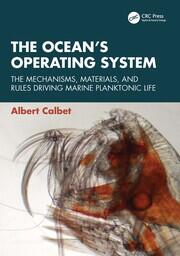
The Ocean’s Operating System The Mechanisms, Materials, and Rules Driving Marine Planktonic Life
About the Author
Preface
Glossary
Part I — Major players and core rules
1. The ocean’s cast: who actually runs the sea?
2. Life at low Reynolds number: viscosity rules the microscale
3. Physical rate governors: temperature, light, and pressure
4. Chemistry as language
5. Gels and microhabitats
6. Size rules
Part II — Processes that move energy and matter
7. Borrowed energy: mixotrophy, symbiosis, theft
8. The mechanisms of feeding
9. Defenses and deterrents
10. Turbulence: the sculptor at small scales
11. Building with minerals: the passive branch of the carbon pump
12. Diel vertical migration
13. The planktonic food web: networks that govern flow
14. Viruses and parasites: mortality, recycling, and control
Part III — Landscapes and edges
15. Nutrients and vertical structure: Sea surface microlayer, thermoclines, nutriclines, DCMs, OMZs
16. Upwelling margins and retention zones
17. Edges: cryosphere, seafloor and shores, and human footprints
Part IV — Time, information, and practice
18. Seeds, cysts, and resting stages
19. Fast evolution, slow constraints
20. Molecular and genomic ecology
21. Reading ahead: ocean forecast, early warnings, and management
Biography
Albert Calbet is a marine scientist at the Institute of Marine Sciences (ICM-CSIC) in Barcelona. His research focuses on the ecology and ecophysiology of micro- and mesozooplankton, with influential work on the role of microzooplankton in marine food webs. He earned a Ph.D. in Marine Sciences from ICM-CSIC in 1997 and completed postdoctoral training at the University of Hawai‘i at Mānoa. At ICM-CSIC, he has also served in leadership roles, including Deputy Director. Calbet has published over 130 peer-reviewed papers, contributed books and book chapters, and frequently presents at international conferences. He teaches and mentors students across undergraduate, master’s, and doctoral levels, reviews for funding agencies, serves on editorial boards, and actively engages in public outreach through websites, social media, and popular-science books writing.
“The Ocean’s Operating System offers something different: an ‘easy’ reader of some of the basics of the small-scale physics and biology of the ocean. It fills a huge gap in the literature for bachelor and higher-level students, communicating rather difficult technical stuff without the use of equations. The language is beautiful and captures the reader: Albert Calbet manages to explain complicated and counter-intuitive things in a simple way without compromising scientific rigor. I have been missing such a book when teaching introductory marine ecology!”
Professor Thomas Kiørboe, National Institute of Aquatic Resources, Technical University of Denmark
“The Ocean’s Operating System fills a genuine gap in the current literature. Most books about marine ecosystems are structured taxonomically or narratively. In contrast, this book focuses on mechanisms, constraints, and physical–biological principles. I agree with the rationale: the approach is thought‑provoking and innovative. The content is strong, comprehensive, and thoughtfully organized, and the emphasis on physics, materials, and ecological “devices” is refreshing. It has the potential to become a durable reference for mechanism‑oriented marine ecology and advanced teaching.”
Dr Chris Bowler, Director of Research at CNRS and Head of Plant and Algal Genomics Lab at IBENS, France
“The development of a ‘user-friendly’ set of rules to explain how the physical and chemical principles of ocean processes can explain the biology and ecology of marine planktonic organisms is very imaginative and exciting. The book has a unique approach with the potential to greatly influence the education of the next generation of marine biology and oceanography students, as well as being an important resource for a wide range of professionals. The writing is exceptional: it is scientifically rigorous and, unlike much academic writing, elegant, engaging and easy to follow. I was ‘hooked’ as soon as I started reading!”
Dr Colin Munn, Honorary Fellow, Marine Institute, University of Plymouth
