





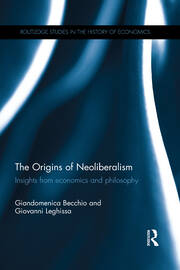
1st Edition
The Origins of Neoliberalism Insights from economics and philosophy
Contents
List of tables
Introduction: The counter-revolution of neoliberalism
This book's contents
1 Foucault and beyond
1.1 Foucault’s distinction between liberalism and neoliberalism
1.2 The neo-Marxist conception of neoliberalism
1.3 The relationship between state action and economy
1.4 Neoliberalism and the question of systemic complexity
2 The building of economics as a science
2.1 The revolution of marginalism: how political economy became economics
2.2 General economic equilibrium and econometrics in the 1930s: from Vienna to Chicago
2.3 The Americanization of the discipline: building mainstream economics
2.4 The rise of neoliberalism in Chicago: the hegemonic role of both neoliberalism and neoclassical economics
3 The building of individuals as rational agents
3.1 Economic rationality and homo oeconomicus: from Vienna and Lausanne to Chicago
3.2 The theoretical and methodological distance between Vienna and Chicago
3.3 Karl Polanyi’s critique of neoliberalism
4 Turning the world into a firm
4.1 Neoliberalism and the political role of the firm
4.2 The neoliberal theory of organizations
4.3 Institutions, evolution and the frame of individual choices: or, farewell from the neoclassic nuts and bolts
Postscript: A new ethics for a new liberalism?
Index
Biography
Giandomenica Becchio is Assistant Professor of Economics at the University of Turin, Italy.
Giovanni Leghissa is Assistant Professor of Philosophy at the University of Turin, Italy.
