




202 Pages
by
Routledge
202 Pages
by
Routledge
202 Pages
by
Routledge
Also available as eBook on:
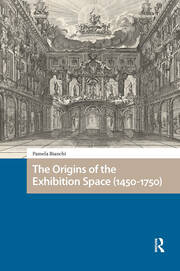
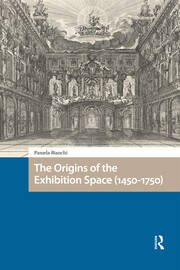
Before the first purpose-designed exhibition spaces and painting exhibitions emerged, showing art was mainly related to the habit of dressing up spaces for political commemorations, religious festivals, and marketing strategies. Palaces, cloisters, façades, squares, and shops became temporary and privileged venues for art display, where sociability was performed, and the idea of exhibition... Read more
Acknowledgments, 1. INTRODUCTION, 1.1 Reasons for a Research, 1.2 Topics, Frames and Methodology, 2. Main Topics, 2.1 The Topoi of the Exhibition Space, 2.2 From the Act of Showing to the Idea of Exhibiting, 2.3 Depicting the Exhibitions, 2.4 Early Exhibition Design Precepts and Treatises, 3. (Domestic) Interiors, 3.1 Dressing Up Environments. From Representative Spaces to Exhibition Rooms, 3.2 Aesthetic Promenades in Italian Noble Palaces, 3.3 Dutch and Venetian Burghers' Dwellings, 3.4 A Proper Place for Artefacts, 3.5 Setting-Up the Collections, 3.6 Directing the Viewers' Gaze,*Spaces in Between,*Ubi Papa, Ibi Roma. Furniture and Display Apparatus, 4. (Public) Exteriors, 4.1 Gardens, Outer Loggias and Inner Galleries, 4.2 The City: a Stage to Display Ceremonies, 4.3 Religious Spaces for Early Exhibitions, 4.4 Transitional Space for Exhibition Fairs in Florence and Venice, 4.5 Other Venues of Exhibiting. Italian Botteghe and Northern Panden, 4.6 Alternative Exhibition Spaces: Eighteen-century Paris, 5. Conclusion, 5.1 The psychology of the display, Bibliography, List of Illustrations, Index.
Biography
Pamela Bianchi is a lecturer in art history and exhibition design at the École Nationale Supérieure d’Architecture de Paris-Belleville (Paris), France, specialising in the relationship between art and architecture.
