





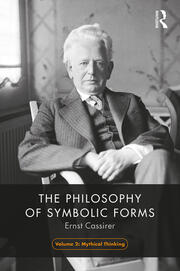
1st Edition
The Philosophy of Symbolic Forms, Volume 2 Mythical Thinking
Foreword Peter E. Gordon; Translator’s Preface Steve G. Lofts; Translator’s Introduction: A Transcendental Critique of Mythical-Religious Consciousness: Identity-Thinking, the Natural Attitude, and an Immanence in the Sacred Sense of Life Steve G. Lofts; Translator’s Acknowledgements Steve G. Lofts; Preface; Introduction: The Problem of A "Philosophy of Mythology" Part 1: Myth as Thought-Form 1. The Character and Basic Tendency of Mythical Object Consciousness 2. The Individual Categories of Mythical Thinking Part 2: Myth as Form of Intuition: The Construction and Organization of the Spatialtemporal World in Mythical Consciousness 1. The Basic Opposition 2. The Basic Features of a Morphology of Myth: Space, Time, and Number Part 3: Myth as Life-Form: The Discovery and Determination of Subjective Reality in Mythical Consciousness 1. The I and the Soul 2. The Forming Emergence of the Feeling of Self from the Mythical Feeling of Unity and Life 3. Cult and Sacrifice Part 4: The Dialectic of Mythical Consciousness. Glossary of German Terms; Index.
Biography
Ernst Cassirer was born in Germany 1874 in the city of Breslau (now Wroclaw, Poland). He taught at Hamburg University from 1919 to 1933, and then at All Souls College, Oxford, before emigrating to Sweden and then to the United States. Through its creative interpretation of Kant’s philosophy combined with a deep knowledge of the role of language and culture, Cassirer’s work is regarded as indispensable to understanding the relationship between the two major traditions in twentieth-century philosophy, the "analytic" and the "continental". Cassirer’s philosophy is unique, as it sought a common ground between the scientific and humanistic worldviews which frequently divided these two traditions, exemplified in his famous debate with Martin Heidegger at Davos in 1929. His work resulted in the monumental Philosophy of Symbolic Forms as well as several books on the philosophy of humanism and the Enlightenment. He taught at the universities of Yale and Columbia in the early 1940s and died in New York in 1945.
Steve G. Lofts is Professor of Philosophy at King’s University College, Canada. He is the translator of Cassirer’s The Logic of the Cultural Sciences and The Warburg Years (1919-1933): Essays on Language, Art, Myth, and Technology.
'The three volumes of The Philosophy of Symbolic Forms focus on language, myth, and science respectively, offering fascinating, if necessarily fragmentary and speculative, accounts of how each develops in the direction of increasing freedom and universality… the basic insight of The Philosophy of Symbolic Forms is one that continues to inform the humanities today. The categories we use to understand the world aren’t a passive reflection of the way things really are; rather, we actively create systems of meaning that evolve over time.' - Adam Kirsch, New York Review of Books
