





1st Edition
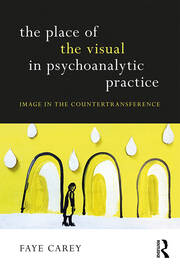
The Place of the Visual in Psychoanalytic Practice Image in the Countertransference
CONTENTS
Acknowledgements
INTRODUCTION
1. WHAT IS A MENTAL IMAGE?
2. SPATIALITY, DIMENSIONALITY AND THE VISUAL
3. UNCONSCIOUS COMMUNICATION:
Projection, Projective Identification Reverie and Countertransference
4. CONSIDERATIONS OF REPRESENTABILITY
5. DYNAMICS OF IMAGERY
6. VISUAL REVERIE: THE THERAPIST’S DAYDREAM
7. CONCLUSION
References
Biography
Faye Carey is a psychoanalytic psychotherapist in private practice in London, UK, and Chair of Training for the London Centre for Psychotherapy.
"Faye Carey has written a book that is engaging, challenging, even inspiring. Her book is scholarly, as she traces the development of ideas about the use of imagery by both patient and analyst in the psychoanalytic literature, and also passionate, as she regards the devaluation of the visual within psychoanalytic theory and practice in favour of the verbal as having deprived analytic practitioners of a rich and potentially liberating source of material for making better sense of their patients’ internal world."
Laurence Spurling, Senior Lecturer in Psychosocial Studies, School of Social Science, History and Philosophy, Birkbeck College, University of London
"A bird, a spider, a laundrette, a busy junction: this fascinating, lucid book explores the occurrence of ‘oblique’, fugitive visual images in the analyst’s mind. With an impressive depth of theoretical understanding, Faye Carey systematically guides the reader through ideas about internal space, reverie and projective processes, representation and representability, images in relation to words, and the dynamic, collaborative nature of image construction: the unbidden image can be a crucible for unconscious processing. Drawing mainly on British and American sources, and enlivening her text with case material and with her own sketches, Carey has produced a work of satisfying richness."
Robert Snell, Psychoanalytic Psychotherapist, British Psychotherapy Foundation
