



1st Edition
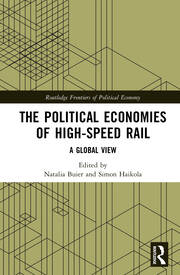
The Political Economies of High-Speed Rail A Global View
List of figures
List of contributors
Foreword by Anthony Perl
Acknowledgements
List of acronyms
Introduction: Political economies of high speed rail
Natalia Buier and Simon Haikola
Part 1. Pioneers and leaders
1. Japan
The World Bank and the Shinkansen
Jessamyn R. Abel
2. France
The TGV: public service vs. profitability
Raymond Woessner
3. Spain
Not meant to succeed: Spanish high speed rail and the elusive search for commercial rail
Natalia Buier
4. China
Interactive development: The rise of China’s high speed railway system
Karl Yan
Part 2. Contenders and followers
5. UK
HS2 and the construction and dismantling of the national legacy narrative in the UK
Geoffrey Dudley, David Banister & Tim Schwanen
6. Taiwan
Navigating through challenges: The evolution of Taiwan's high speed rail from privatisation to nationalisation after 2007
Kuo-Hui Chang
7. Morocco
Banking on rails: colonial concessionaires, capital flows, and green bonds in the political economy of Moroccan railways
Cristiana Strava
8. Denmark and Germany
High Speed across the Fehmarn Belt
Dan Durrant
Part 3. Dissenters and sceptics
9. United States
United States high speed rail: A politics of mobility perspective
Andrew R. Goetz & Jason Henderson
10. Canada
Explaining the absence of high speed rail in Canada: insurmountable political economic and geographical barriers
Ryan Katz-Rosene
11. Sweden
An uncomfortable compromise – The unravelling of Swedish high speed rail as an ecological-modernity vision for transport
Simon Haikola
Index
Biography
Natalia Buier is a Ramón y Cajal researcher at the Complutense University of Madrid. She is the author of Frontiers of Appropriation: Spanish High-Speed Rail and Capitalist Environment-Making (Berghahn, 2026) and co-editor (with Susana Narotkzy and Theodora Vetta) of Agricultural Extractivism in the Mediterranean Region: A Socioecological View.
Simon Haikola is a senior associate professor at the Department of Thematic Studies – Technology and Social Change at Linköping University, Sweden. He investigates the politics of the environment with a focus on the state and how state policies are implemented across scales.
