




1st Edition
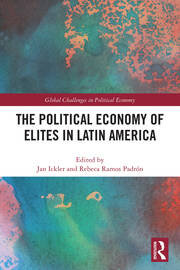
The Political Economy of Elites in Latin America
1. Introduction: The Political Economy of Elites in Latin America
Jan Ickler and Rebeca Ramos Padrón
Part I Elites in the Political Economy of Latin America
2. Brazilian Agribusiness and Aviation: Intra-Elite Competition and Accommodation, Cross-Class Exclusion and Incorporation
Aaron Schneider
3. Economic Elites and Public Sector Size in Brazil and Mexico
Gabriel Ondetti
4. Economic Elites and Development with Equity in Bolivia and Ecuador
Eduardo Silva and Fabio Resmini
5. Entrenching Mexican Corporate Elites in Global Corporate Networks (and Vice-Versa)
Alejandra Salas Porras and Martí Medina Hernández
Part II Elites and the State in Latin America
6. Chile and the Contemporary Power of Capital: Peripheral Predatory Rentier Capitalism and the Political Practices of Business Elites
Fernando Ignacio Leiva
7. Business and State Relations in Uncertain Times: Alliance Recalibration in Nicaragua
Rose J. Spalding
8. From Plutocracy to Modernity in Bolivia: Economic Elites Adapting to the State Transformation under the MAS Government
Thomas Chiasson-LeBel
Part III Elites, Wealth, and Power
9. Earning but Not Leading: Argentina’s Economic Elites and the Exercise of Power in Global Capitalism
Mariana Heredia
10. Discursive Power in Central America: Economic Elites and Disputes over Public Policies during the COVID-19 Pandemic
Francisco Robles-Rivera, Gustavo Fuchs and Ximena Alvarenga Fournier
11. Wealth Concentration in Latin America: The Role of Direct Taxation
Juan Pablo Jiménez, Fernando Lorenzo, James Mahon and Gustavo Viñales
12. Trusts: Searching for the Hidden Treasure in Ecuador
Jonathan Báez Valencia
Index
Biography
Jan Ickler is a researcher and Ph.D. candidate at the University of Kassel and coordinator at the Center for Advanced Latin American Studies (CALAS). He is focusing his doctoral research on the role of economic elites in Latin America’s political economy. He studied philosophy, political sciences, and sociology and obtained his Master’s degree in political economy.
Rebeca Ramos Padrón is a postdoctoral researcher within the CALAS-Laboratory Project Confronting Inequalities in Latin America: Perspectives on Wealth and Power. Previously, Ramos was a DAAD fellow as a visiting professor in the Department of Political Science at the University of Kassel. For over 20 years, she worked as a professor in the Chair of Sociology at the University of Havana (UH), serving as its vice-director for 7 years. Ramos completed her Ph.D. in sociology at the UH and her MA in International Social Work at the University of Gothenburg, Sweden. Member of the UNESCO Chair on Sustainable Human Development-UH and consultant for UN-HABITAT-Cuba. She has published on issues related to social policy systems, employment, and labor market insertion from a perspective of social inequalities, socio-ecological transformation, and human development in Cuba and Latin America.
As inequality deepens and morphs globally, it is urgent to understand the actors and driving forces behind it. This book offers a comprehensive understanding of how elite interests and organization impact inequality, the state, and the economy in Latin America, but also of how elites change in response to current shifts in capitalism and geopolitics. Bringing together brilliant young scholars with established influential academics, it provides a welcome addition to a booming literature on Latin American elites. It is essential for anyone keen on understanding the potential for building more just, egalitarian, and sustainable societies, in Latin America and beyond.
- Benedicte Bull, Professor, Centre for Development and the Environment, University of Oslo.
