




1st Edition
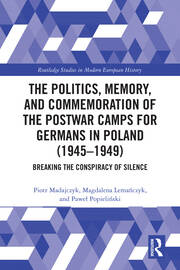
The Politics, Memory, and Commemoration of the Postwar Camps for Germans in Poland (1945-1949) Breaking the Conspiracy of Silence
Introduction
Characterising sociological studies
Part I The memory of the camps in the political context
In communist Poland
Departure point: the 1940s
The fear of remembering in the policies of the PPR security apparatus
Politics and remembering the camps
Łambinowice – the breaktrough of 1977
After the 1989 transition
Breaking the taboo in Poland
The memory of the camps
Łambinowice, Świętochłowice, Potulice
The significance and instrumentalisation of memory in the 21st century
Part II Memory in flux
The symbolism of the postwar camps in Poland and the problem of trauma
Connotations
Camp-related terminology and categorising prisoners
A sense of stigma
Memory and commemoration: between emotions and politics
Motivations behind involvement in commemoration
Sources of knowledge about the camps
The problem of politicising commemoration
Memory contexts: dimensions, creations, and (re)interpretations
Language and narratives
Obstacles to commemoration
Suggested forms of commemoration
Mysterious ways of commemorations: challenges and risks
Challenges in holding commemoration
Difficult cooperation on commemorating the camps
Are we forgetting? The issue of the postwar camps in Poland in the Polish and German public spheres
Concluding remarks
APPENDIX
Works cited
Archives
Polish press – national and regional periodicals
Secondary sources
Internet sources
Biography
Piotr Madajczyk, 1959, is a historian and political scientist and Head of the Department of the Institute of Political Studies, Polish Academy of Sciences. He is a member of the scientific board in the German “Foundation Flight, Expulsion, Reconciliation” (Berlin). His research interests cover the history of ethnic cleansing and forced migration, Polish-German relations in the 20th century, and the German minority in Poland. His most recent publications have focused on Raphael Lemkin and the Second World War. ORCID 0000-0002-2788-8404.
Magdalena Lemańczyk, PhD, is Deputy Director for Scientific Affairs and Head of the Department of Research on Social and Institutional Transformations at the Institute of Political Studies, Polish Academy of Sciences. She is Executive Editor of the ISA RC25 journal Language, Discourse & Society. Her research focuses on Polish-German relations in the 20th and 21st centuries, minority and migration issues, and social innovations. ORCID 0000-0002-3958-175X.
Paweł Popieliński, PhD, 1976, is a sociologist, political scientist, and researcher of national and ethnic minorities. He is Assistant Professor at the Department of German Studies at the Institute of Political Studies of the Polish Academy of Sciences and Secretary of the scientific journal „Rocznik Polsko-Niemiecki“ (Polish-German Annual). In his scientific activity, he focuses on the issues of the German minority and the topic of Upper Silesia and "Silesianness" in the 20th and 21st centuries. His area of interest also includes the Tatar minority in Poland and the Roma minority in Poland and the Federal Republic of Germany. ORCID 0000-0001-7137-813X.
