




1st Edition
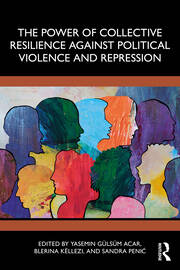
The Power of Collective Resilience Against Political Violence and Repression
Collective resilience against political violence and repression: An introduction
Yasemin Gülsüm Acar, Blerina Këllezi & Sandra Penić
I. Beyond trauma: Collective resilience in coping with victimisation
A social identity model of collective resilience in emergent groups
John Drury & Evangelos Ntontis
Understanding collective resilience of civilians in the contexts of political violence and repression
Orla Muldoon, Anna-Mariya Lashkay, Alžběta Lebedová, Dearbhla Moroney, Catriona Shelly, & Lisa Skilton
The good, the bad and the ugly: Social cure and social curse in the context of political violence and repression
Blerina Këllezi
II. Beyond resignation: Collective resilience as resistance
“They are not your cheerleaders, mate, they are coming to fight the fight.” Media presentations of women’s collective resilience and resistance in the Sudan revolution
Sigrun Marie Moss, Lara-Sabina Sorgenfrei, & Salma Mohamed Abdalmunim Abdalla
Resilience versus Resistance? Insights from the Recent Multiple-Crises Context of Lebanon
Yara Zebian, Haneen Eldiri, & Rim Saab
Rethinking collective resilience under oppression through Kurdish understandings of power and resistance
canan coşkan & Helin Ünal
The power of Black resilience: The role of history in contributing to collective resilience
Hema Preya Selvanathan & Phia Salter
Collective Resilience and Resistance
Carmen Marazzi, Aritra Mukherjee, & Johanna Ray Vollhardt
III. Beyond ‘us vs. them’: Inclusive resilience
Inclusive resilience in violent settings
Sandra Penić, Guy Elcheroth, John Dixon, & Simon Hug
Altruism born of suffering: How empathy, compassion, and self-compassion promote coping with violence
Patricia Cernadas Curotto
Beyond Vulnerability: Collective Victimization Beliefs that are Linked to Collective Resilience
Hu Young Jeong, Michelle S. Twali, & Johanna Ray Vollhardt
Remembering, resilience, and intergroup relations
Sandra Obradović
The power and limits of collective resilience: Conceptualising collective resilience that recognizes the impact of political violence and repression on groups and societies
Blerina Këllezi, Yasemin Gülsüm Acar, & Sandra Penić
Biography
Yasemin Gülsüm Acar is Lecturer in the School of Psychology and Neuroscience at the University of St Andrews, UK. Yasemin’s research interests include outcomes of collective action, social identity, and intergroup conflict.
Blerina Këllezi is Associate Professor in Social and Trauma Psychology at Nottingham Trent University, UK. Blerina’s research investigates the collective nature of the experiences, impact and responses to mass human rights violations.
Sandra Penić is a senior researcher and lecturer at the University of Geneva, Switzerland. Sandra’s research examines the impact of collective victimization on individuals’ emotions, beliefs, and actions in various conflict-affected societies.
This book outlines the importance of collective resilience for groups who have faced challenging or threatening circumstances, such as war and political violence. Drawing on novel research from a range of diverse contexts, the book explores a nuanced picture of how political violence can lead to increased social cooperation and action within communities, as well as the well documented negative dynamics. It brings together researchers studying the collective resilience of civilians in the context of political violence and repression in three fields: psychological well-being, resistance and collective action, and reconciliation and peacebuilding.
