




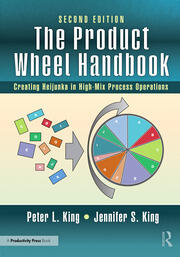
2nd Edition
The Product Wheel Handbook Creating Heijunka in High-Mix Process Operations
Acknowledgments
Introduction
About the Authors
1. Why Product Wheels – Challenges Facing Operations Managers
2. The Solution – Product Wheels
3. The Product Wheel Design and Implementation Process
4. Step 1 – Begin with an Up-to-Date, Reasonably Accurate VSM
5. Step 2 – Collect and Organize All the Required Master Data
6. Step 3 – Decide on the Technology to Be Used
7. Step 4 – Cellular Flow and Product Allocation
8. Step 5 – Decide Where to Use Wheels to Schedule Production
9. Step 6 – Analyze Products for a Make-to-Order Strategy
10. Step 7 – Analyze the Factors Influencing Overall Wheel Time
11. Step 8 – Put It All Together – Determine Overall Wheel Time and Wheel Frequency for Each Product
12. Step 9 – Calculate Inventory Requirements
13. Step 10 – Distribute Products across the Wheel Cycles – Balance the Wheel
14. Step 11 – Determine the Optimum Sequence for Each Cycle
15. Step 12 – Plot the Wheel Cycles
16. Step 13 – Review with Stakeholders
17. Step 14 – Revise the Scheduling Process
18. Step 15 – Develop an Implementation Plan
19. Step 16 – Develop a Contingency Plan
20. Step 17 – Get All Inventories in Balance
21. Step 18 – Confirm Wheel Performance – Put an Auditing Process in Place
22. Step 19 – Put a Plan in Place to Rebalance the Wheel Periodically
23. Prerequisites for Product Wheels
24. Product Wheels and the Path to Pull
25. Unintended Consequences – Inappropriate and Appropriate Use of Metrics
26. Cultural Transformation and Product Wheel Design – The Synergy
27. Examples of Product Wheel Benefits
Appendix A: Cycle Stock Concepts and Calculations
Appendix B: Safety Stock Concepts and Calculations
Appendix C: Total Productive Maintenance and OEE
Appendix D: The SMED Changeover Improvement Process
Appendix E: Group Technology and Cellular Flow
Bibliography
Index
Biography
Peter L. King is the president of Lean Dynamics, LLC, a manufacturing improvement consulting firm located in Rehoboth Beach, DE. Prior to founding Lean Dynamics, Pete spent more than 30 years with the DuPont Company, in a variety of control systems, manufacturing systems engineering, Continuous Flow Manufacturing, and Lean Manufacturing assignments. That included 18 years applying Lean Manufacturing techniques to a wide variety of products, including sheet goods like DuPont™ Tyvek®, Sontara®, and Mylar®; fibers such as nylon, Dacron®, Lycra®, and Kevlar®; automotive paints; performance lubricants; bulk chemicals; adhesives; electronic circuit board substrates; and biological materials used in human surgery. On behalf of DuPont, Pete consulted with key customers in the processed food and carpet industries. Pete retired from DuPont in 2007, leaving a position as Principal Consultant in the Lean Center of Competency. Recent clients have included producers of sheet goods, lubricants, fuel additives, polyethylene and polypropylene pellets, salad dressings, potato and corn chips, pharmaceuticals, vitamin tablets, and cheese sauces and puddings.
Pete received a bachelor’s degree in Electrical Engineering from Virginia Tech, graduating with honors. He is Six Sigma Green Belt certified (DuPont, 2001), Lean Manufacturing certified (University of Michigan, 2002) and is a Certified Supply Chain Professional (APICS, 2010). He is a member of the Association for Manufacturing Excellence, APICS, and the Institute of Industrial Engineers. He served as president of IIE’s Process Industry Division in 2009 – 2010.
Pete is the author of Lean for the Process Industries – Dealing with Complexity (Productivity Press, 2009, 2019), several other books published by Productivity Press, and a dozen published articles on the application of lean concepts to process operations. He has been an invited speaker at several professional conferences and meetings.
DuPont™, Tyvek®, Sontara®, Kevlar® are trademarks or registered trademarks of E. I. D duPont de Nemours and Company. Mylar® is a trademark of DuPont Teijin Films; Dacron® and Lycra® are trademarks of Koch.
Jennifer S. King is an Operations Research Analyst with Regulus Group, analyzing operational impacts of emerging FAA technologies and developing cost and performance models to support airline investment decisions. Prior to that, she spent five years with the Department of Defense developing discrete event simulation models to assist the army in setting reliability requirements for new platforms, and analyzing performance of weapon systems alternatives. Her prior publishing experience includes editing textbooks and developing mathematics problems and solutions for ExploreLearning, and co-authoring the first edition of this book and Value Stream Mapping for the Process Industries.
Jennifer has degrees in Mathematics and Psychology from the University of Virginia, and a Masters degree in Operations Research from the University of Delaware. She is a member of INFORMS.
